GENESIS, EXODUS, JUDGES
4,000 to 1,100 BC
by Serge Janouin-Benanti
Translated by Eva N. Siskowski Boatwright
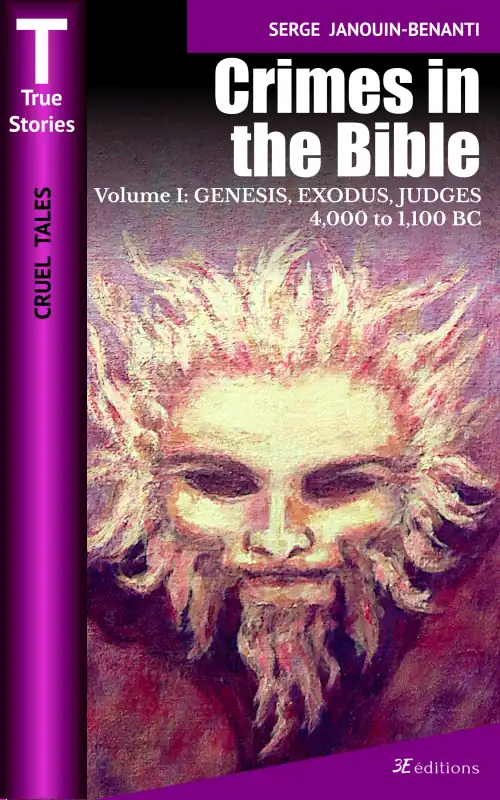
“Crimes in the Bible – Volume I: GENESIS, EXODUS, JUDGES – 4,000 to 1,100 BC” is one of those books that sounds like a stunt at first… and then quietly turns into something you can’t put down.
Serge Janouin-Benanti, known in French for his “Cruel Tales” based on real criminal cases, has decided to treat the Bible as if it were exactly that: the oldest true-crime archive in the world. Deprived of his usual tools—no court records, no police files, no press coverage—he works with biblical texts alone, enriched by historical and archaeological research, and rewrites a selection of episodes as tightly constructed crime narratives.
The result is a strangely addictive mix of thriller, historical reconstruction, and theological provocation.
A true-crime tour through Genesis, Exodus, and Judges
Volume I covers roughly 3,000 years of biblical history, from Cain and Abel to the near-civil war that almost wipes out the tribe of Benjamin. It’s organized not by biblical chapter, but by crime:
- Fratricide
- The Unknown Crime
- Pimping and Attempted Infanticide
- Rape and Incest
- Multiple Deceptions, Rape, Murders
- Murder, Purges, War Crimes, Assassinations
- Genocides
- Multiple Fratricides
- Infanticide
- Gang Rape, Murder, Dismemberment
- Fratricidal War, Abduction, and Rape
Those blunt titles set the tone. Serge Janouin-Benanti uses modern legal language—infanticide, war crimes, genocide—to force us to confront what’s actually happening in these stories, stripped of pious varnish. Yet he never simply mocks or dismisses the text. His bet is more subtle: if we read these episodes like case files, what do they tell us about power, fear, faith, and human violence?
Each tale is built as a short narrative with a prologue, a central story, and an “Epilogue” that reconnects what we’ve just read to biblical genealogies and later events. Maps locate the action (Eden and the land of Nod, Abraham’s journeys, the routes of the Exodus and the conquest of Canaan), and reproductions of paintings and engravings—Rubens’s Cain Killing Abel, Rembrandt’s Moses Breaking the Tablets of the Law, scenes of Dinah’s abduction or Jericho’s fall—underscore the grim drama.
You can dip in anywhere, but the book does have a powerful cumulative effect if you read straight through.
Genesis: the crimes of the founding family
The opening story, “Fratricide”, retells Cain’s murder of Abel as a psychological thriller. We’re back in a world only recently expelled from Eden: Adam is condemned to till the ground, and Cain, as eldest son, accepts the same harsh calling, sweating over ungrateful soil. Abel, by contrast, becomes a shepherd—“the easy option” in Cain’s eyes.
Serge Janouin-Benanti lingers over the unequal offerings: Abel brings the best of his flock, Cain brings the fruits of his labor, convinced that obedience and suffering are what God most wants. When Yahweh favors Abel’s offering, the author has Abel calmly—and somewhat smugly—explain why his sacrifice was superior. Cain suddenly realizes his younger brother has outmaneuvered him spiritually. In a flash of jealousy and humiliation, he kills Abel with a stick, hides the body in the bushes, and is then confronted by the God who hears “your brother’s blood crying out…from the earth.”
The “Epilogue” coolly follows the aftermath: Cain’s exile to the land of Nod (which Serge Janouin-Benanti situates in what is now Afghanistan), his descendants, and their eventual annihilation in the Flood.
A map shows the geography of this first crime.
The effect is to make Cain less a cardboard villain and more the tragic origin of all later violence.
The second Genesis tale, “The Unknown Crime,” tackles one of the Bible’s most enigmatic passages: Noah’s drunkenness, his nakedness, and the curse on Canaan. Serge Janouin-Benanti doesn’t “solve” the puzzle; instead, he constructs a tense domestic scene, draws out the dynamics between Noah, his sons, and grandson, and leaves readers feeling the weight of an unnamed transgression. The crime, as the title indicates, is literally unknown—another reminder that ancient texts often leave victims and motives partially obscured.
From there, the stories edge closer to what we might call “domestic noir”:
- “Pimping and Attempted Infanticide” follows Abraham as he presents his wife Sarah as his “sister” to foreign rulers, exposing her to sexual danger to save his own skin, and later takes Isaac up the mountain with a knife and firewood. Serge Janouin-Benanti’s angle is clear: if you pulled Abraham out of Scripture and dropped him into a modern courtroom, what would his charge sheet look like?
- “Rape and Incest” revisits Lot fleeing the destruction of Sodom and Gomorrah, hiding with his daughters in a cave, and unknowingly fathering children by them after they make him drunk. The narrative gives the two young women distinct voices: they fear dying childless, they long for sexual experience, they rationalize their plan as securing descendants. Their pregnancies lead to the birth of Moab and Ben-Ammi, founders of the Moabites and Ammonites, and the epilogue firmly links a horrifying family secret to later people and territories.
- In “Multiple Deceptions, Rape, Murders,” Jacob’s daughter Dinah is abducted and raped by Shechem, a local prince who then asks to marry her. Jacob’s sons Simeon and Levi demand that all the men of the city be circumcised as a condition for peace—and once the men are disabled, they slaughter them. Serge Janouin-Benanti brings out the layers of deceit, honor, and manipulation in this story of “restorative” violence that becomes its own atrocity, and then shows how the family carries the consequences into their later lives.
Genesis ends with a “Transition” chapter that briefly recounts Joseph’s sale into slavery, his rise to power in Egypt, and the family’s relocation to Goshen—setting the stage for the next act: Egypt, slavery, and Exodus.
Exodus: war crimes in the name of God
The Exodus section may be the one that will unsettle religious readers the most—not because Serge Janouin-Benanti adds anything lurid, but because he simply applies our modern vocabulary to the biblical text.
In “Murder, Purges, War Crimes, Assassinations,” he follows Moses from his clandestine birth (hidden from Pharaoh’s order to kill all Hebrew baby boys) to his life in the palace, his impulsive killing of an Egyptian, and his flight into exile.
The prologue efficiently sketches the demographic anxiety behind Pharaoh’s decree: Israelites are prospering, Egyptians are not, and immigration plus cultural difference turns into state-sponsored violence.
As Moses returns to demand Israel’s freedom, the familiar plagues, the drowning of the Egyptian army, and the crushing of internal dissent among the Israelites are all narrated with the cool eye of someone counting casualties. Later, in the wilderness, Serge Janouin-Benanti highlights incidents that are usually passed over quickly in Sunday school: Levites killing their fellow Israelites after the golden calf, or Phinehas spearing a couple mid-act to stop a plague. These are, in his framing, extrajudicial executions and religiously motivated killings. They remain acts of obedience to Yahweh within the narrative, but the book’s title invites you to consider their moral status under the word “crime.”
The final Exodus story, “Genocides,” follows Joshua as he prepares to conquer Canaan after Moses’ death. Standing on Mount Nebo with the high priest Eleazar, Joshua surveys the land and confesses his doubts: the country is vast, the cities well-fortified, the responsibility crushing. Eleazar reassures him: Yahweh will destroy the nations; walls will fall; cities will be given over to Israel. The conversation is almost military: concerns about morale, logistics, and discipline, underwritten by divine promises.
The subsequent campaigns—Jericho, Ai, and beyond—are condensed but vivid, with attention to tactics and aftermath. Serge Janouin-Benanti doesn’t revel in gore, but he doesn’t soften the language either: whole populations are “devoted to destruction.” The “Epilogue” then shows how the conquered land is divided among the tribes, how Reuben and Gad negotiate to stay east of the Jordan, and how Moses himself is denied entry into the land, allowed only to see it before dying at 120.
A map presents various proposed routes for the Exodus and Moses’ exile in Midian, underscoring how contested even the geography remains.
Judges: when “everyone did what was right in his own eyes”
If Genesis is about family crimes and Exodus about nation-building violence, the book’s final section, on Judges, reads like a descent into complete chaos.
Here, Israel is in the Promised Land but politically fragmented. Charismatic “judges” arise to lead tribes or coalitions, and the line between hero and warlord is razor-thin.
In “Infanticide,” Judge Jephthah vows to sacrifice the first thing that comes out of his house if Yahweh grants him victory over the Ammonites—only to see his only daughter run out to meet him with tambourines. Serge Janouin-Benanti’s retelling of the episode is brutally straightforward: there is no last-minute reprieve, no ram as with Abraham and Isaac. Jephthah keeps his vow; his daughter dies; a new annual commemoration is born in Israel’s calendar. The epilogue adds the chilling coda: Jephthah later leads a war against the tribe of Ephraim, where 42,000 men die, identified and slaughtered based on a linguistic shibboleth—whether they can pronounce “Sh” instead of “S.”
In “A Traitorous and Venal Companion,” Samson’s story is told in full: announced by an angel before birth, raised as a Nazirite, spectacularly strong and spectacularly impulsive. He marries a Philistine woman, falls into cycles of personal revenge, visits prostitutes, and finally falls for Delilah, whose name here isn’t just shorthand for betrayal but a real woman under pressure from Philistine leaders. Serge Janouin-Benanti emphasizes Samson’s restlessness and Delilah’s calculation, making their relationship feel less like a moral fable and more like the toxic love story at the center of many modern crime dramas.
The darkest chapters are reserved for the end.
“Gang Rape, Murder, Dismemberment” recounts the nightmare of the Levite who, traveling with his secondary wife (often called his concubine), stops for the night in the Benjamite town of Gibeah. The men of the town surround the house. By morning, his wife is dead after a night of sexual violence. The Levite takes her body home, dismembers it into twelve pieces, and sends one to each tribe with a message: this is what happened in Israel—judge this crime and respond.
Serge Janouin-Benanti narrates the dismemberment in stark, workmanlike detail and then shifts into something almost like a modern courtroom drama. At Mizpah, representatives from all tribes gather, with 400,000 armed men standing by. The Levite gives his statement. Skilled Benjamite advocates present a counter-narrative, calling a hundred witnesses and even summoning Levite priests who describe a supposed “divine punishment” that drives some women to insatiable sexual behavior. The aim is to claim the victim was not raped at all but afflicted by a curse and therefore responsible for what happened to her.
The Levite’s response is one of the book’s most powerful moments: he denounces the attempt to make the victim into the culprit, accuses the priests and lawyers of perjury and misogyny, and demands justice. The tribes ultimately condemn the men of Gibeah and demand that Benjamin hand them over—or face war.
Benjamin refuses. War follows.
The final chapter, “Fratricidal War, Abduction, and Rape,” traces that civil conflict and its horrific aftermath. The other tribes nearly exterminate Benjamin, leaving only 600 surviving men. Then they realize they have created a new problem: they have sworn not to give their daughters as wives to Benjaminites. To preserve the tribe without “breaking” their oath, they orchestrate two further crimes: a massacre of the town of Jabesh-Gilead, sparing only virgin girls to be handed to Benjamin, and later a mass abduction of dancing girls at a festival in Shiloh. When devastated fathers protest about their kidnapped daughters, priests reassure them: they are not breaking their vow, since they did not personally give the girls away. The logic is chilling, and Serge Janouin-Benanti lets it speak for itself.
The book closes on the biblical line that might serve as the epigraph to the whole series:
“In those days, there was no king in Israel. Everyone did what was right in his own eyes.”
Style, method, and the reading experience
Two things make this volume stand out.
First, Serge Janouin-Benanti’s method. As the opening endorsement points out, he does here what he usually does with modern cases: sticks as close to the known facts as possible, then uses character psychology and narrative framing to make the story come alive.
He leans on multiple Bible translations (Segond, Chouraqui, Darby, etc.), Midrashic commentary, the Quran for parallel traditions, and historical/archaeological works to reconstruct settings and timelines.
The “invented” elements are mostly inner thoughts, dialogue, and descriptive texture—the kinds of things historians can’t access but novelists can supply.
Second, his tone. The prose (in Eva N. Siskowski Boatwright’s translation) is straightforward and accessible. There’s no academic jargon, no heavy theological argument, and no need to know the Bible in advance. Each story is self-contained, with enough context woven in that a reader unfamiliar with, say, Jephthah or Micah can follow what’s going on. At the same time, if you do know the Bible, you’ll catch dozens of details that show how carefully he has read the source text.
Calling these “true crime” is not just a marketing gimmick. The book really does read like a series of historical case files, each with:
- A prologue framing the time and place
- A narrative of the crime(s) and immediate consequences
- An epilogue explaining the longer-term fallout
The maps and artworks give a pleasing “documentary” feel, as if you were leafing through a dossier prepared for a trial.
Who is this book for?
This volume sits in a curious but fertile intersection:
- If you like true crime, you’ll find familiar beats here: motives, escalating tensions, acts of violence, courtroom-style confrontations, and chilling rationalizations.
- If you’re interested in biblical studies or ancient history, you’ll appreciate how the author takes difficult passages seriously rather than smoothing them over.
- If you’re a believer willing to confront the Bible’s darkest episodes, this book can serve as a brutally honest companion to those texts—though it is definitely not devotional literature.
- If you’re secular or simply curious, it offers the Bible as you may never have encountered it: not as a book of consolation, but as a mirror reflecting humanity’s capacity for cruelty and self-justification.
It’s also very readable in short bursts. Each story functions as a standalone novella; you can read “Fratricide” over coffee, “Genocides” on a train ride, “Gang Rape, Murder, Dismemberment” in an evening—though that last one may mess with your sleep.
A caveat: the subject matter is extremely dark. Sexual violence, child sacrifice, massacres, and genocidal campaigns are treated frankly. Serge Janouin-Benanti doesn’t sensationalize them, but he doesn’t euphemize them either. This isn’t a book for younger readers or for anyone seeking a sanitized version of scripture.
Verdict: worth reading?
“Crimes in the Bible – Volume I” is provocative by design, but it isn’t cheap provocation. There’s no sneering, no attempt to “debunk” faith with easy shots. Instead, Serge Janouin-Benanti does something more interesting: he treats biblical characters as fully human—jealous, fearful, ambitious, loving, cruel—and asks what happens when those humans wield power in a world where the voice of God can be invoked to justify almost anything.
The stories we “thought we knew by heart” really do feel new.
Cain becomes a tragic eldest son whose crime haunts the rest of human history. Lot’s daughters go from a shocking footnote to complex survivors of catastrophe. Jephthah’s daughter, the Levite’s wife, the abducted girls of Shiloh—often marginal in traditional readings—emerge here as the emotional core of their respective tales.
And over everything hangs that closing line from Judges: everyone doing what is right in their own eyes. In a world still struggling with religious violence, ethnic cleansing, and the weaponization of oaths and ideals, this ancient anthology of crimes feels unnervingly contemporary. If you’re ready to let the Bible unsettle you, and you enjoy narrative nonfiction that reads like a series of historical thrillers, this first volume of Crimes in the Bible is absolutely worth your time—and will likely leave you eager (and a little apprehensive) to see what horrors and questions the next volumes will bring.
Where to buy the book:
Price: $22.00
Price: $13.00
Price: $4.99