Category: Criminal Tales

  • Crimes in the Bible – Volume I

    Crimes in the Bible – Volume I

    GENESIS, EXODUS, JUDGES

    4,000 to 1,100 BC

    by Serge Janouin-Benanti

    Translated by Eva N. Siskowski Boatwright
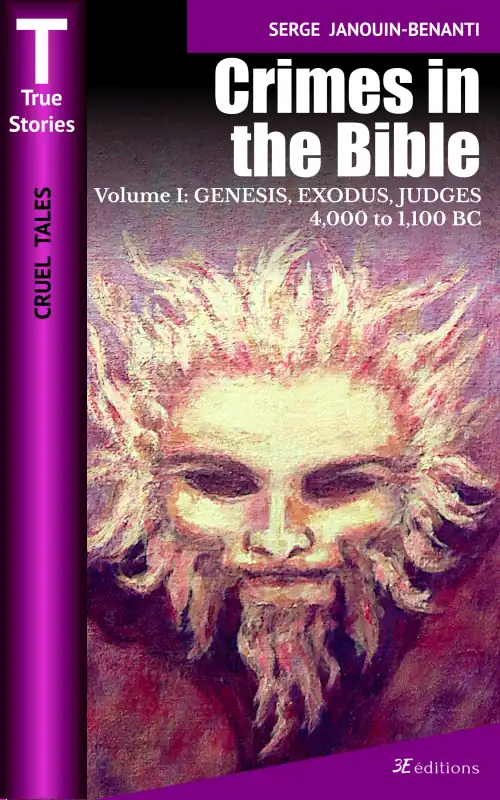
    Book cover: Crimes in the Bible, Volume 1, Genesis, Exodus, Judges

    “Crimes in the Bible – Volume I: GENESIS, EXODUS, JUDGES – 4,000 to 1,100 BC” is one of those books that sounds like a stunt at first… and then quietly turns into something you can’t put down.

    Serge Janouin-Benanti, known in French for his “Cruel Tales” based on real criminal cases, has decided to treat the Bible as if it were exactly that: the oldest true-crime archive in the world. Deprived of his usual tools—no court records, no police files, no press coverage—he works with biblical texts alone, enriched by historical and archaeological research, and rewrites a selection of episodes as tightly constructed crime narratives.

    The result is a strangely addictive mix of thriller, historical reconstruction, and theological provocation.


    A true-crime tour through Genesis, Exodus, and Judges

    Volume I covers roughly 3,000 years of biblical history, from Cain and Abel to the near-civil war that almost wipes out the tribe of Benjamin. It’s organized not by biblical chapter, but by crime:

    • Fratricide
    • The Unknown Crime
    • Pimping and Attempted Infanticide
    • Rape and Incest
    • Multiple Deceptions, Rape, Murders
    • Murder, Purges, War Crimes, Assassinations
    • Genocides
    • Multiple Fratricides
    • Infanticide
    • Gang Rape, Murder, Dismemberment
    • Fratricidal War, Abduction, and Rape

    Those blunt titles set the tone. Serge Janouin-Benanti uses modern legal language—infanticide, war crimes, genocide—to force us to confront what’s actually happening in these stories, stripped of pious varnish. Yet he never simply mocks or dismisses the text. His bet is more subtle: if we read these episodes like case files, what do they tell us about power, fear, faith, and human violence?

    Each tale is built as a short narrative with a prologue, a central story, and an “Epilogue” that reconnects what we’ve just read to biblical genealogies and later events. Maps locate the action (Eden and the land of Nod, Abraham’s journeys, the routes of the Exodus and the conquest of Canaan), and reproductions of paintings and engravings—Rubens’s Cain Killing Abel, Rembrandt’s Moses Breaking the Tablets of the Law, scenes of Dinah’s abduction or Jericho’s fall—underscore the grim drama.

    You can dip in anywhere, but the book does have a powerful cumulative effect if you read straight through.


    Genesis: the crimes of the founding family

    The opening story, “Fratricide”, retells Cain’s murder of Abel as a psychological thriller. We’re back in a world only recently expelled from Eden: Adam is condemned to till the ground, and Cain, as eldest son, accepts the same harsh calling, sweating over ungrateful soil. Abel, by contrast, becomes a shepherd—“the easy option” in Cain’s eyes.

    Serge Janouin-Benanti lingers over the unequal offerings: Abel brings the best of his flock, Cain brings the fruits of his labor, convinced that obedience and suffering are what God most wants. When Yahweh favors Abel’s offering, the author has Abel calmly—and somewhat smugly—explain why his sacrifice was superior. Cain suddenly realizes his younger brother has outmaneuvered him spiritually. In a flash of jealousy and humiliation, he kills Abel with a stick, hides the body in the bushes, and is then confronted by the God who hears “your brother’s blood crying out…from the earth.”

    The “Epilogue” coolly follows the aftermath: Cain’s exile to the land of Nod (which Serge Janouin-Benanti situates in what is now Afghanistan), his descendants, and their eventual annihilation in the Flood.

    A map shows the geography of this first crime.

    The effect is to make Cain less a cardboard villain and more the tragic origin of all later violence.

    The second Genesis tale, “The Unknown Crime,” tackles one of the Bible’s most enigmatic passages: Noah’s drunkenness, his nakedness, and the curse on Canaan. Serge Janouin-Benanti doesn’t “solve” the puzzle; instead, he constructs a tense domestic scene, draws out the dynamics between Noah, his sons, and grandson, and leaves readers feeling the weight of an unnamed transgression. The crime, as the title indicates, is literally unknown—another reminder that ancient texts often leave victims and motives partially obscured.

    From there, the stories edge closer to what we might call “domestic noir”:

    • “Pimping and Attempted Infanticide” follows Abraham as he presents his wife Sarah as his “sister” to foreign rulers, exposing her to sexual danger to save his own skin, and later takes Isaac up the mountain with a knife and firewood. Serge Janouin-Benanti’s angle is clear: if you pulled Abraham out of Scripture and dropped him into a modern courtroom, what would his charge sheet look like?
    • “Rape and Incest” revisits Lot fleeing the destruction of Sodom and Gomorrah, hiding with his daughters in a cave, and unknowingly fathering children by them after they make him drunk. The narrative gives the two young women distinct voices: they fear dying childless, they long for sexual experience, they rationalize their plan as securing descendants. Their pregnancies lead to the birth of Moab and Ben-Ammi, founders of the Moabites and Ammonites, and the epilogue firmly links a horrifying family secret to later people and territories.
    • In “Multiple Deceptions, Rape, Murders,” Jacob’s daughter Dinah is abducted and raped by Shechem, a local prince who then asks to marry her. Jacob’s sons Simeon and Levi demand that all the men of the city be circumcised as a condition for peace—and once the men are disabled, they slaughter them. Serge Janouin-Benanti brings out the layers of deceit, honor, and manipulation in this story of “restorative” violence that becomes its own atrocity, and then shows how the family carries the consequences into their later lives.

    Genesis ends with a “Transition” chapter that briefly recounts Joseph’s sale into slavery, his rise to power in Egypt, and the family’s relocation to Goshen—setting the stage for the next act: Egypt, slavery, and Exodus.


    Exodus: war crimes in the name of God

    The Exodus section may be the one that will unsettle religious readers the most—not because Serge Janouin-Benanti adds anything lurid, but because he simply applies our modern vocabulary to the biblical text.

    In “Murder, Purges, War Crimes, Assassinations,” he follows Moses from his clandestine birth (hidden from Pharaoh’s order to kill all Hebrew baby boys) to his life in the palace, his impulsive killing of an Egyptian, and his flight into exile.

    The prologue efficiently sketches the demographic anxiety behind Pharaoh’s decree: Israelites are prospering, Egyptians are not, and immigration plus cultural difference turns into state-sponsored violence.

    As Moses returns to demand Israel’s freedom, the familiar plagues, the drowning of the Egyptian army, and the crushing of internal dissent among the Israelites are all narrated with the cool eye of someone counting casualties. Later, in the wilderness, Serge Janouin-Benanti highlights incidents that are usually passed over quickly in Sunday school: Levites killing their fellow Israelites after the golden calf, or Phinehas spearing a couple mid-act to stop a plague. These are, in his framing, extrajudicial executions and religiously motivated killings. They remain acts of obedience to Yahweh within the narrative, but the book’s title invites you to consider their moral status under the word “crime.”

    The final Exodus story, “Genocides,” follows Joshua as he prepares to conquer Canaan after Moses’ death. Standing on Mount Nebo with the high priest Eleazar, Joshua surveys the land and confesses his doubts: the country is vast, the cities well-fortified, the responsibility crushing. Eleazar reassures him: Yahweh will destroy the nations; walls will fall; cities will be given over to Israel. The conversation is almost military: concerns about morale, logistics, and discipline, underwritten by divine promises.

    The subsequent campaigns—Jericho, Ai, and beyond—are condensed but vivid, with attention to tactics and aftermath. Serge Janouin-Benanti doesn’t revel in gore, but he doesn’t soften the language either: whole populations are “devoted to destruction.” The “Epilogue” then shows how the conquered land is divided among the tribes, how Reuben and Gad negotiate to stay east of the Jordan, and how Moses himself is denied entry into the land, allowed only to see it before dying at 120.

    A map presents various proposed routes for the Exodus and Moses’ exile in Midian, underscoring how contested even the geography remains.


    Judges: when “everyone did what was right in his own eyes”

    If Genesis is about family crimes and Exodus about nation-building violence, the book’s final section, on Judges, reads like a descent into complete chaos.

    Here, Israel is in the Promised Land but politically fragmented. Charismatic “judges” arise to lead tribes or coalitions, and the line between hero and warlord is razor-thin.

    In “Infanticide,” Judge Jephthah vows to sacrifice the first thing that comes out of his house if Yahweh grants him victory over the Ammonites—only to see his only daughter run out to meet him with tambourines. Serge Janouin-Benanti’s retelling of the episode is brutally straightforward: there is no last-minute reprieve, no ram as with Abraham and Isaac. Jephthah keeps his vow; his daughter dies; a new annual commemoration is born in Israel’s calendar. The epilogue adds the chilling coda: Jephthah later leads a war against the tribe of Ephraim, where 42,000 men die, identified and slaughtered based on a linguistic shibboleth—whether they can pronounce “Sh” instead of “S.”

    In “A Traitorous and Venal Companion,” Samson’s story is told in full: announced by an angel before birth, raised as a Nazirite, spectacularly strong and spectacularly impulsive. He marries a Philistine woman, falls into cycles of personal revenge, visits prostitutes, and finally falls for Delilah, whose name here isn’t just shorthand for betrayal but a real woman under pressure from Philistine leaders. Serge Janouin-Benanti emphasizes Samson’s restlessness and Delilah’s calculation, making their relationship feel less like a moral fable and more like the toxic love story at the center of many modern crime dramas.

    The darkest chapters are reserved for the end.

    “Gang Rape, Murder, Dismemberment” recounts the nightmare of the Levite who, traveling with his secondary wife (often called his concubine), stops for the night in the Benjamite town of Gibeah. The men of the town surround the house. By morning, his wife is dead after a night of sexual violence. The Levite takes her body home, dismembers it into twelve pieces, and sends one to each tribe with a message: this is what happened in Israel—judge this crime and respond.

    Serge Janouin-Benanti narrates the dismemberment in stark, workmanlike detail and then shifts into something almost like a modern courtroom drama. At Mizpah, representatives from all tribes gather, with 400,000 armed men standing by. The Levite gives his statement. Skilled Benjamite advocates present a counter-narrative, calling a hundred witnesses and even summoning Levite priests who describe a supposed “divine punishment” that drives some women to insatiable sexual behavior. The aim is to claim the victim was not raped at all but afflicted by a curse and therefore responsible for what happened to her.

    The Levite’s response is one of the book’s most powerful moments: he denounces the attempt to make the victim into the culprit, accuses the priests and lawyers of perjury and misogyny, and demands justice. The tribes ultimately condemn the men of Gibeah and demand that Benjamin hand them over—or face war.

    Benjamin refuses. War follows.

    The final chapter, “Fratricidal War, Abduction, and Rape,” traces that civil conflict and its horrific aftermath. The other tribes nearly exterminate Benjamin, leaving only 600 surviving men. Then they realize they have created a new problem: they have sworn not to give their daughters as wives to Benjaminites. To preserve the tribe without “breaking” their oath, they orchestrate two further crimes: a massacre of the town of Jabesh-Gilead, sparing only virgin girls to be handed to Benjamin, and later a mass abduction of dancing girls at a festival in Shiloh. When devastated fathers protest about their kidnapped daughters, priests reassure them: they are not breaking their vow, since they did not personally give the girls away. The logic is chilling, and Serge Janouin-Benanti lets it speak for itself.

    The book closes on the biblical line that might serve as the epigraph to the whole series:

    “In those days, there was no king in Israel. Everyone did what was right in his own eyes.”


    Style, method, and the reading experience

    Two things make this volume stand out.

    First, Serge Janouin-Benanti’s method. As the opening endorsement points out, he does here what he usually does with modern cases: sticks as close to the known facts as possible, then uses character psychology and narrative framing to make the story come alive.

    He leans on multiple Bible translations (Segond, Chouraqui, Darby, etc.), Midrashic commentary, the Quran for parallel traditions, and historical/archaeological works to reconstruct settings and timelines.

    The “invented” elements are mostly inner thoughts, dialogue, and descriptive texture—the kinds of things historians can’t access but novelists can supply.

    Second, his tone. The prose (in Eva N. Siskowski Boatwright’s translation) is straightforward and accessible. There’s no academic jargon, no heavy theological argument, and no need to know the Bible in advance. Each story is self-contained, with enough context woven in that a reader unfamiliar with, say, Jephthah or Micah can follow what’s going on. At the same time, if you do know the Bible, you’ll catch dozens of details that show how carefully he has read the source text.

    Calling these “true crime” is not just a marketing gimmick. The book really does read like a series of historical case files, each with:

    • A prologue framing the time and place
    • A narrative of the crime(s) and immediate consequences
    • An epilogue explaining the longer-term fallout

    The maps and artworks give a pleasing “documentary” feel, as if you were leafing through a dossier prepared for a trial.


    Who is this book for?

    This volume sits in a curious but fertile intersection:

    • If you like true crime, you’ll find familiar beats here: motives, escalating tensions, acts of violence, courtroom-style confrontations, and chilling rationalizations.
    • If you’re interested in biblical studies or ancient history, you’ll appreciate how the author takes difficult passages seriously rather than smoothing them over.
    • If you’re a believer willing to confront the Bible’s darkest episodes, this book can serve as a brutally honest companion to those texts—though it is definitely not devotional literature.
    • If you’re secular or simply curious, it offers the Bible as you may never have encountered it: not as a book of consolation, but as a mirror reflecting humanity’s capacity for cruelty and self-justification.

    It’s also very readable in short bursts. Each story functions as a standalone novella; you can read “Fratricide” over coffee, “Genocides” on a train ride, “Gang Rape, Murder, Dismemberment” in an evening—though that last one may mess with your sleep.

    A caveat: the subject matter is extremely dark. Sexual violence, child sacrifice, massacres, and genocidal campaigns are treated frankly. Serge Janouin-Benanti doesn’t sensationalize them, but he doesn’t euphemize them either. This isn’t a book for younger readers or for anyone seeking a sanitized version of scripture.


    Verdict: worth reading?

    “Crimes in the Bible – Volume I” is provocative by design, but it isn’t cheap provocation. There’s no sneering, no attempt to “debunk” faith with easy shots. Instead, Serge Janouin-Benanti does something more interesting: he treats biblical characters as fully human—jealous, fearful, ambitious, loving, cruel—and asks what happens when those humans wield power in a world where the voice of God can be invoked to justify almost anything.

    The stories we “thought we knew by heart” really do feel new.

    Cain becomes a tragic eldest son whose crime haunts the rest of human history. Lot’s daughters go from a shocking footnote to complex survivors of catastrophe. Jephthah’s daughter, the Levite’s wife, the abducted girls of Shiloh—often marginal in traditional readings—emerge here as the emotional core of their respective tales.

    And over everything hangs that closing line from Judges: everyone doing what is right in their own eyes. In a world still struggling with religious violence, ethnic cleansing, and the weaponization of oaths and ideals, this ancient anthology of crimes feels unnervingly contemporary. If you’re ready to let the Bible unsettle you, and you enjoy narrative nonfiction that reads like a series of historical thrillers, this first volume of Crimes in the Bible is absolutely worth your time—and will likely leave you eager (and a little apprehensive) to see what horrors and questions the next volumes will bring.


    Where to buy the book:

    Amazon

    Price: $22.00

    Price: $13.00

    Price: $4.99

  • Poisoners

    Poisoners

    13 Criminal Cases of Poisonings from around France

    by Serge Janouin-Benanti

    Translated by Eva N. Siskowski Boatwright

    Book cover: Poisoners, 13 Criminal Cases of Poisonings from around France

    Here’s a book that turns true crime into a country-wide road trip, one arsenic pinch at a time. Poisoners — 13 Criminal Cases of Poisonings from around France gathers thirteen historical cases and retells them as brisk, novelistic short stories, each planted in a different city or village and each orbiting that most intimate, secretive method of murder: poison. The author, Serge Janouin-Benanti, has long specialized in “true and cruel tales,” and here he lines up a gallery of schemers and victims—lovesick spouses, swaggering frauds, fortune-tellers, self-styled healers—then lets the courts, the newspapers, and the nascent science of toxicology close the net. It’s a collection built for anyone who likes their history with momentum and their mysteries with receipts. The book is presented in English translation by Eva N. Siskowski Boatwright and openly grounded in archival sources (national, departmental, and period press), a fact that keeps the dramatization anchored throughout.

    What the collection is (and how it reads)

    A “map of the crimes” lists the thirteen tales and their waypoints—from Marseille to Tarbes, Antwerp to the rural Astarac—promising both variety and a slow, cumulative portrait of nineteenth-century life under the shadow of easy-to-buy toxins. The volume foregrounds that these stories are inspired by true events, and it includes an “About the Author/Translator” note that situates Serge Janouin-Benanti’s scientific background and Boatwright’s literary competence. That blend—method and narrative—gives the book its snap: every scene swings like fiction, every conclusion rests on filings, testimonies, and autopsies.

    A sampler of standout cases

    1) The poison shops of Marseille

    The opener, “The Poisoners of Marseille,” is as sociological as it is suspenseful. In a humid whirl of jealousies and cash-on-the-counter remedies, we meet Lamberte, a fortune-teller with a clientele, and Joye, an “herbalist–sorcerer” with a backroom full of products that do “neither good nor harm”—until they do. Joye has even concocted theriac, a Renaissance-style antidote of sixty-nine ingredients in honey he touts as universal protection, a telling glimpse of the era’s credulity and the hustles that fed on it.

    Serge Janouin-Benanti stages the plot like a crime novel: a lover’s triangle; a suspicious physician whose Marsh apparatus inconveniently explodes mid-test; and, finally, a police raid on Joye’s “spell room” at 27 Rue Saint-Antoine, where officers seize 505 grams of arsenic acid plus packets of belladonna and celandine—the story’s coolly horrifying talismans.

    The courtroom crescendo in Aix-en-Provence is deliciously theatrical. The attorney general booms that if the racket had continued, “a few more years, and all of Marseille would have been wiped out,” while defense lawyers sketch the widows as battered, credulous, and led step by step into crime by professional poison-mongers. The verdict keeps you thinking: suppliers Joye and Lamberte, plus widows Ville and Gabriel, receive hard labor for life; Salvago gets twenty years; alleged accomplices Dye and Flayol walk free. The crowd cheers the acquitted and jeers the rest—a snapshot of public opinion, which is as much a character in this story as any witness.

    2) The poisoned princes of Tarbes

    If Marseille shows a network, “The Poisoned Cakes of Tarbes” shows one man’s petty vendetta. In 1895, night-shift postal workers open a parcel addressed to a retired gendarme named Fortuné Cabarrou. Inside: four “princes,” chocolate cakes crowned with candied cherries. The curious postman Auguste Borromée nicks a bite; a bitter burn spreads across his tongue. Within hours he’s dead; colleagues who barely tasted the confection survive after urgent care. A forensic pathologist peers under the cherry and tastes the crystals—strychnine—“the poison of the moment,” he remarks, with sick, clinical certainty.

    The culprit? A schoolteacher, Gérard Contre, who bought cakes at Augé on Rue des Grands-Fossés, laced them with strychnine, and mailed them with a clumsy love note from “Suzanne.” He’s arrested fast and tries a crafty defense: he claims he only added saltpeter—a laxative—blaming a pharmacist for any mix-up. The jury splits hairs: not guilty for Borromée’s death, guilty (with mitigation) for attempted poisoning of Cabarrou. Seven years’ hard labor. The story packs moral torque—about mischievous curiosity, about the luck of dosage, about the thin line between prank and murder.

    3) Gilt-edge homicide in Antwerp

    Across the border, “The Poisoner of Antwerp” follows Marie-Thérèse Joniaux, a society woman whose polished composure wobbles only when anyone hints her husband might have been complicit. The trial’s scale—296 witnesses and experts—makes it an endurance sport. The press snarks that Belgium sips her famous cases “in small sips,” but the effect is cumulative: after weeks of testimony and a prosecutor’s closing that aligns character and circumstance like clockwork, the jury votes guilty on three poisonings. The court pronounces death, then King Leopold II’s de-facto moratorium transforms it into life in Mons. It’s a study in privilege, patience, and how a performance can harden into a mask.

    4) “Sentenced to Death by Persuasion”

    The most chillingly titled tale tracks Jean-Claude Aymé, who decides that revenge should arrive as dessert. On New Year’s Eve in Paris, he buys eleven cakes from five different pastry shops, hires a café scribe to pen decoy notes, and has street kids hand off boxes so no one can identify him. Then he fills the cakes with arsenic, smoothing the jam to hide the punctures and sprinkling the remaining powder on top—it looks like icing sugar—before sending them to his targets. The economy of the plan—and its grotesque banality—stick with you long after the chapter ends.

    5) “Honey Bear and Turtle Dove”

    If you can handle a darker plunge, the title refers to the pet names of Jean-Claude Jacquemard and Françoise Briot, lovers who wait, mid-tryst, for his wife Marguerite to die in the next room. They have already dosed her sugar water; their dialogue—callous, giddy, obscene—plays against the woman’s final cries. Then the seven-year-old daughter listens from behind the door, terrified and certain of what her father has done. Later, with money draining, the pair eye a life-annuity house and stage a serial solution: dose the elderly sellers, Monsieur and Madame Caulet, because “they’re old, no one will pay it any attention.” The author lets the horror speak without amplification.

    But the chapter’s secret star is an investigating judge who turns to science and psychology. He lectures Jacquemard (off the record) on Marsh’s test and the famed Mathieu Orfila, warning that arsenic leaves traces and juries love science; then he batters the suspect with irregular interviews until the façade trembles. It’s riveting procedural storytelling—and a neat primer on how forensic chemistry, invented in the 1830s, rewired justice by the 1860s.

    6) “I’m Going to Kill You All!”

    Mass poisoning, industrial suburb: in Saint-Denis, a deliveryman named Baude retaliates against his baker boss by dumping arsenic into the flour. The town reels; doctors count 300-plus residents sickened, and a dog dies of a high dose. Tried in Paris in 1880, Baude gets death, then—because the baker himself petitions for mercy alongside jurors and clients—President Jules Grévy commutes the sentence to hard labor for life. The paradox is haunting: public compassion for a would-be mass killer, spearheaded by the man he aimed to ruin.

    7) “Don’t Wake the Dead”

    When Jeanne Gilbert is suspected of killing relatives, a cousin suggests the simplest path to truth: authorize an autopsy. Her answer—“We must never wake the dead; we must let them rest in peace”—gives the story its title and spine. In a collection fascinated by evidence, this is the counter-theme: silence, propriety, and the powerful taboo against disturbing the grave, even when rumor corrodes the living.

    8) “Nothing to Understand?”

    The closing piece is less whodunit than indictment of bureaucratic neatness. In the Boeglin affair, a young woman goes from death sentence to acquittal on appeal—an outlier so awkward that a minister literally strikes the anomalous “1” from his report summary. The line between “explained” and “filed away” has rarely looked thinner; the coda leaves you with the discomfort of unanswered motives and the soft censorship of statistics.

    What ties the book together

    Poisons are the obvious ligature—chiefly arsenic and strychnine, alternately subtle and spectacular. The Marseille chapter even details how mixing belladonna with arsenic masks symptoms and increases arsenic tolerance, a macabre “innovation” gleaned from encyclopedias and peddled as folk know-how. Elsewhere, the Tarbes pathologist’s glance under a pastry cherry turns into a pocket lesson in forensic heuristics; in Côte-d’Or and Haute-Saône, Marsh’s test moves from laboratory bench to courtroom rhetoric. The book doubles as a plain-spoken history of how we learned to see what poisoners hoped was invisible.

    But the human throughline is even richer. Serge Janouin-Benanti is tuned to class (brothels and drawing rooms, farms and boulangeries), gender (why juries sometimes forgave women more readily for the “weapon of the coward,” as one judge puts it), and the public theater of justice (cheers for acquittals, jeers for “poison shops”). You feel how gossip becomes evidence, how newspaper sarcasm shapes expectation, how a confident defendant can seem charming until the timeline of debts and deaths clicks together like gears.

    How it’s told (and why it works)

    Serge Janouin-Benanti writes compact scenes that begin in motion—a door half-open on an eager adulteress; a postman cracking twine; a night courier pressing coins into a boy’s palm. He favors dialogue that sounds lived-in and chooses details that do two jobs: the bitter taste on a cake, the address “27 Rue Saint-Antoine,” the gaudy glass of a pastry box. Those specifics establish time and place while nudging the plot forward. As each chapter closes, the author resists lecturing; instead, the court (and sometimes the crowd) delivers a moral the story refuses to pin down. It’s persuasive precisely because it doesn’t tell you what to think; the sentences and juries do that.

    The translation reads clean and nimble. Boatwright keeps the tone elastic, capable of handling crooked humor (the Tarbes postman’s gluttony) and blunt cruelty (Jacquemard’s bedroom whispers) without smoothing out the edges that make these period voices feel local and particular. The result is immersion without fuss—a clarity that serves the book’s documentary backbone and lets its drama breathe. The opening pages even collect a pair of crisp early notices that frame the project’s promise: a “genuine tour through France one poison apple at a time” and a “bottomless pit” for crime writers’ imagination. It’s a playful touch, but it fits: these are stories that stick to your ribs.

    Who it’s for (and how to read it)

    If you devour true-crime podcasts, love historical mysteries, or want a smart companion to nineteenth-century French life beyond Balzac and Zola, this is an easy recommendation. Read it in order to watch the forensic and legal threads knit tighter, or out of order as thirteen compact shocks. Either way, it invites reflection. Consider how often money sits at the center (annuities, insurance, shop revenues), how often reputation constrains action (the shame of brothels, the pride of pharmacists), and how frequently collective feeling—a jeering crowd, a pleading petition—reshapes justice’s trajectory. The case of Baude in Saint-Denis (doomed, then saved) and the Boeglin footnote (a life flipped between two verdicts, then politely erased) offer mirror images of that social power.

    Bottom line: why you’ll want to read it

    Because it moves. Because it teaches without preaching. Because it treats the past not as a postcard but as a place where people make small, terrible choices for reasons that feel uncomfortably familiar. The book’s architecture—a tour of thirteen places tied by a single, secretive weapon—means you can finish a story at lunch and still think about it at dinner. You’ll come away with characters (Joye and his theriac; the indignant Marie-Thérèse Joniaux; the broken-hearted baker who begs mercy for the man who ruined him), scenes (a pathologist squinting under a cherry; a judge whispering about Orfila), and questions about culpability, gender, class, and the crowd’s appetite for punishment. Most of all, Poisoners gives you the sensation of history freshly felt. The sources are there; the scaffolding shows; yet each chapter lands like a short noir. It’s the rare true-crime collection that rewards curiosity as much as it gratifies it—one that trusts readers to connect the dots between lab glass, love letters, and the human hunger for both justice and spectacle. If that sounds like your blend, clear an evening: these thirteen doses are potent.


    Where to buy the book:

    Amazon

    Price: $25.00

    Price: $16.00

    Price: $4.99


  • Killer Doctors

    Killer Doctors

    The True Crimes of Dr. Petiot
    & Other Murderous Physicians

    by Serge Janouin-Benanti

    Translated by Eva N. Siskowski Boatwright

    Book cover: Killer Doctors, The True Crimes of Dr. Petiot and Other Murderous Physicians

    Here’s a book that does something sly and satisfying with true crime: it wraps thirteen meticulously retold cases of murderous physicians inside a taut prison-cell drama, turning history into a series of midnight confessions. Serge Janouin-Benanti’s Killer Doctors, The True Crimes of Dr. Petiot & Other Murderous Physicians isn’t a thriller, these are true stories, but it reads like one, anchored by a dialogue between guard and prisoner that frames every case, sharpens the stakes, and keeps you turning pages to the very end. The author’s conceit (and the book’s big payoff) is to let one infamous doctor, Marcel Petiot, “teach” his night guard, Pierre, about other doctors who killed. The result feels, as one early notice aptly put it, like a dark, Arabian Nights for true crime: each night, another tale unfolds, and each tale refracts Petiot’s shifting self-portrait.

    What it’s about (and why it works)

    The frame opens in La Santé Prison in 1946. A young guard, Pierre, takes over the night shift watching Petiot, the notorious Parisian physician on death row. Their first exchanges are terse, sparring, and electric. Petiot sizes up Pierre, nicknaming him “little sparrow,” and the guard, rattled but dutiful, tries to keep the upper hand. That intimate, claustrophobic setting  -two men, bars between them, hours to kill- becomes the crucible for the book’s thirteen case studies. Each study is “told” by Petiot, as if he can prove that he, a doctor, cannot be the aberration Pierre believes, because physicians have always been capable of murder.

    It’s a brilliant structural choice. Stories arrive as staged lessons, and they’re titled with avian proverbs and metaphors (“The Sparrow and the Eagle Owl,” “The Jay Dressed Up in Peacock Feathers,” “Happy as a Lark”), creating a chorus of fables whose morals are anything but simple. The table of contents reads like a gruesome cabinet of curiosities: Edmond Couty de La Pommerais (insurance, poison, and audacity); Hawley Harvey Crippen (domestic horror dressed in respectability); William Palmer and Théodore Durrant; Castaing; Bougrat; Gorguloff; the Jack the Ripper doctors (Cream and Klosowski); and H. H. Holmes’s “Murder Castle,” among others, braided with recurring chapters on Petiot himself.

    Serge Janouin-Benanti gives the book heft by interleaving Petiot’s own arc -arrest, trial, grandstanding, eerie calm- with the guard’s mounting dread and fascination. The frame propels us inexorably to dawn and the guillotine (Petiot is executed at 5:05 a.m.), but the path to that final page is crowded with ghosts from medical history who make his case (and our judgment) anything but straightforward.

    A tour through the cases

    If you read only one chapter to test what the book can do, make it “The Jay Dressed Up in Peacock Feathers,” on Dr. Edmond Couty de La Pommerais. Petiot recounts, with unnerving relish, how this Parisian doctor engineered a life-insurance scam using an ex-mistress as the insured, and how she died via the “perfect” poison: digitalis. Digitalis leaves no chemical fingerprint, Petiot explains: unless you think like Ambroise Tardieu, the forensic dean who turned to physiology when chemistry failed, using living hearts (dogs, frogs, rabbits) to prove the poison’s effect by the telltale slowing and stoppage of the pulse. The way the author reconstructs that courtroom duel feels almost novelistic: hypothesis, counter-hypothesis, grisly experiments, and finally, the jury’s turn. It’s a forensic procedural staged in miniature, and it lands with a thud.

    The book is full of such explanatory set-pieces, and they’re both chilling and strangely clarifying. La Pommerais instructs a mistress to fake a stairway fall and “collect” diagnoses from top Paris specialists; he hoards a homeopath’s bounty of pure toxins; he counts on digitalis’s undetectability in the autopsy room. The author lets Petiot explain how and why these choices worked, until Tardieu dismantles them. The methodical walk-through (including the recovered vomit between floorboards, sterilized and tested in animals) is as unforgettable as it is macabre.

    Jump continents and decades, and you arrive at “The Murder Castle.” The way Serge Janouin-Benanti renders H. H. Holmes is a study in horror’s architecture. Holmes builds a corner-lot hotel ahead of the Chicago World’s Fair, a labyrinth with secret corridors, two-way mirrors, gas lines routed into rooms, chutes, and a basement outfitted with a furnace, quicklime pit, surgical tables, and a vat of acid. The chapter’s imagery is ghastly, but controlled; you see the machine and the man. And the narrative never loses its anchor: we’re still in La Santé, still listening to Petiot draw lessons from someone else’s monstrosity.

    The “Jack the Ripper” chapter is more speculative but no less gripping. Petiot sifts rival suspects with a doctor’s eye for anatomy and technique, weighing the case against Thomas Neill Cream, the “Lambeth Poisoner,” hanged in 1892, whose alleged last words (“I am Jack…”) turned him into a perennial suspect, and then turning, more persuasively, to Severin Klosowski (a barber-surgeon trained in Warsaw, later executed as wife-poisoner George Chapman). It’s a deft demonstration of the book’s method: sift rumor, test plausibility, and force the reader to think like an investigator.

    The selection is eclectic in the best way. You get domestic poisoners and opportunists (Palmer, Castaing), political assassins (Paul Gorguloff), and colleagues killing colleagues. The timeline stretches across centuries and countries, but the chapters never sprawl; each is shaped to an argument and a mood, and each returns us to Pierre and Petiot, whose nightly debates are the drumbeat under it all.

    Petiot as narrator: charisma, cruelty, and the “sport” of killing

    Let’s be clear: the most unsettling pleasure of this book is being trapped with Petiot long enough to hear him at length. He is manipulative, erudite, and often very funny, in ways that make your stomach drop. He brags about his memory, claims to read 150 pages an hour, delights in chess-like “martingales” for life and death, and is forever testing Pierre’s gullibility. He insists the doctors he killed were “bastards,” that he’s a patriot, and that the justice system botched even its counting: “Not 26… I admitted to 63,” he crows, even as he shifts the terms of his own confessions. Serge Janouin-Benanti doesn’t sanitize any of that; he lets the contradictions accrue until they clang.

    Along the way, Petiot drops aphorisms (and epigraphs) from his prison-written tract Chance Conquered, and the author sprinkles those at the openings of chapters like poisoned bonbons. They sharpen the theme that runs through the whole book: games of chance, games of power, and the fatal allure of believing you can outwit rules, systems, even death. That theme peaks late when Petiot, facing the end, still taunts, still performs, and still treats murder like a contest played for “sport.” Serge Janouin-Benanti stages that bravado against the starkness of the wake-up call, the corridor walk, and the blade. The tension, between swagger and silence, makes the last chapter a punch in the gut.

    How it’s told: pacing, texture, and a translator’s touch

    Two things make these tales feel fresh even if you think you know the case names.

    First, the pacing. Each chapter is a tight braid of storytelling and explanation. The author knows when to dwell on a forensic wrinkle (Tardieu’s “living heart” insight), when to sketch a setting (Holmes’s castle rooms with their concealed valves and chutes), and when to cut back to Pierre, whose discomfort is a moral compass the book never loses. That rhythm keeps the pages moving without ever cheapening the material.

    Second, the texture. The book includes historical photographs and visual plates (anthropometric images of Petiot after his arrest; a spread on Holmes’s hotel and victims) that punctuate the text without turning it into a scrapbook. They’re carefully placed, and they deepen the sense that you’re not just being told about these crimes, you’re being shown their human scale.

    A word on the translation: Eva N. Siskowski Boatwright renders Serge Janouin-Benanti’s French into English with clean, idiomatic snap. She preserves Petiot’s needling tone and the author’s precise, almost playful chapter headings, while keeping the forensic passages crisp. The result reads smoothly for a broad audience, no jargon choke points, no over-literalisms, and still carries the French flavor of the frame. (The book is published by 3E éditions; this English edition is © 2023, ISBN 978-2-37885-072-2.)

    Themes that linger

    By filtering thirteen cases through Petiot’s voice, the book asks you to sit with three discomforts:

    • The double edge of medical authority. Doctors command trust, carry specialized knowledge, and have access to tools: an unbeatable advantage if they choose to harm. Again and again, Serge Janouin-Benanti shows how that trust becomes the weapon: the neat signature on a death certificate, the prescription no one questions, the bedside presence that disarms suspicion. The author doesn’t sensationalize that; he anatomizes it.
    • Forensics as a moral drama. Tardieu’s digitalis breakthrough is science but it reads like theatre: the wrongdoer banking on “undetectable” poison, the expert flipping the problem on its head, the courtroom as stage. The book returns to this pattern, where reasoned method brings order to cruelty, often enough that it becomes a quiet counter-argument to fatalism.
    • Myth-making and the press. Petiot needles Pierre about what newspapers printed about him during and after the Occupation; chapters like Jack the Ripper and Holmes trace how rumor, headlines, and spectacle inflate villains into legends. The book is honest about the allure of those legends and about the damage they do.

    Who will love this

    If you enjoy narrative nonfiction that reads with the urgency of a thriller, you’re in the target zone. Killer Doctors is ideal for readers drawn to forensic history, courtroom strategy, and psychological portraiture. It’s also unusually good for people who think they “don’t read true crime”: the frame story gives the book a novel’s shape, and Pierre’s skepticism gives you a way in even if your first instinct is to recoil.

    Be warned: the content is dark. Some passages (especially on Holmes’s methods and certain Ripper details) are disturbing, though the prose never wallows. The author’s restraint -describing just enough, then stepping back- earns trust.

    Bottom line

    Serge Janouin-Benanti has built a cunning structure out of real horrors: a death-row Socratic seminar in which a killer physician lectures us through a gallery of his kind. It’s propulsive, grimly witty, and uncommonly illuminating about how murders by doctors get planned, executed, covered up, and, sometimes, solved by ingenuity as sly as the crime. By the time the final walk to the guillotine begins, you’ve heard enough to know that Petiot’s insistence on being exceptional is a dodge, and that the exception has a history as long as medicine itself. You don’t need to excuse him to be fascinated by how he thinks; the book counts on that tension and uses it.

    Read it for the cases. Read it for the forensic ingenuity. Read it for the portrait of a manipulator who, even at the end, tries to turn murder into a game, and for the guard who refuses to become his pawn. And if you’re the kind of reader who likes a sly structural flourish, savour the avian titles and the recurring epigraphs from “Chance Conquered”: they’re the flutter of wings you hear before each trap springs. These “cruel tales,” inspired by true events, earn their shiver.

    Credits and edition info: translated by Eva N. Siskowski Boatwright; 3E éditions, 2023; Collection “Cruel Tales”; ISBN 978-2-37885-072-2. Photos and plates include Petiot’s anthropometric shots and spreads on Holmes’s hotel; the table of contents lists thirteen doctor cases interleaved with Petiot chapters.


    Where to buy the book:

    Amazon

    Price: $26.00

    Price: $16.50

    Price: $4.99


    Apple-Books

    Price: $4.99


    Kobo

    Price: $4.99


    Google Books

    Price: $4.99