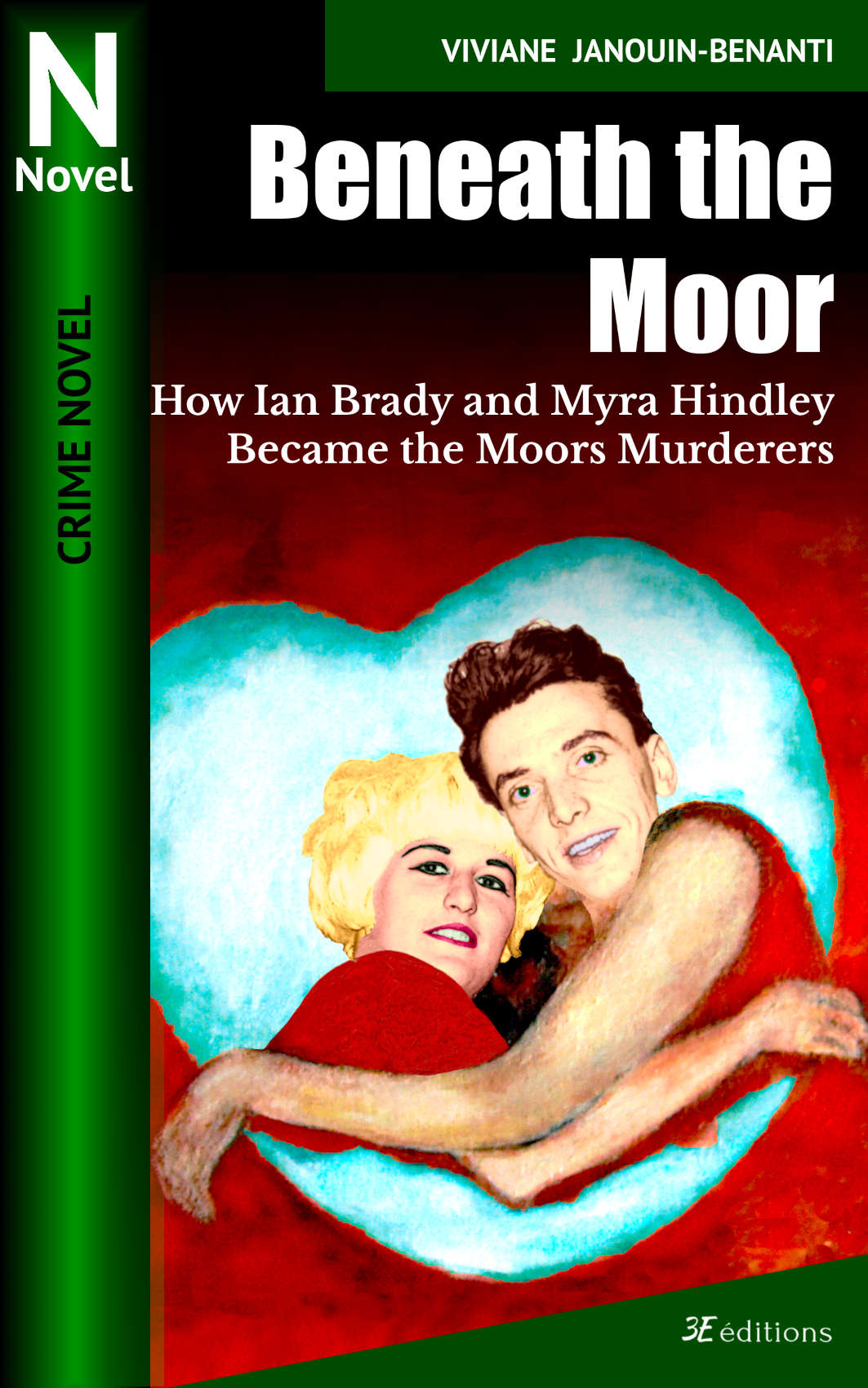
How Ian Brady and Myra Hindley Became the Moors Murderers
By Viviane Janouin-Benanti
Translated into English by Elizabeth Blood
Introduction – When Evil Wears an Ordinary Face
Some crimes exist only in their own time. Others echo across generations, staining the national memory. The Moors Murders, committed in Britain between 1963 and 1965, belong firmly in the latter category. For many, the very names Ian Brady and Myra Hindley conjure a shiver – a reminder of childhood warnings, tabloid headlines, and grainy photographs of a stern-faced woman and a man with cold eyes.
In Beneath the Moor, Viviane Janouin-Benanti approaches this notorious case not with sensationalism, but with a scholar’s precision and a storyteller’s sense of pace. The book promises more than a straightforward crime recap – it seeks to understand how two seemingly ordinary people formed a deadly alliance, and how the psychological chemistry between them turned murderous fantasy into grim reality.
Setting the Stage – Britain in the Early 1960s
Before we meet Brady and Hindley, Viviane Janouin-Benanti paints a picture of the society in which their story unfolds. Post-war Britain was entering a new decade of optimism and cultural transformation. The Beatles were about to conquer the charts, working-class youth found new freedom in fashion and nightlife, and the shadow of wartime rationing was fading. Yet the period’s innocence was fragile.
Against this backdrop, the crimes of the Moors Murderers hit the country like a thunderclap. They were not faceless monsters in a distant place; they were an office worker and a clerk from Manchester – people who could have been your neighbours.
Part One – Childhood Shadows
Viviane Janouin-Benanti devotes substantial space to the killers’ formative years, knowing that understanding their backgrounds is essential to understanding the case.
Ian Brady was born in Glasgow in 1938 to an unmarried waitress, an origin that in that era carried social stigma. Adopted by a couple who struggled to discipline him, Brady was an intelligent child but prone to cruelty and rebellion. By adolescence, he was already dabbling in petty crime and immersing himself in books that glorified domination and violence. Works by Nietzsche, Hitler’s Mein Kampf, and the Marquis de Sade shaped his worldview – one in which empathy was weakness and power was the highest aim.
Myra Hindley, born in 1942 in Manchester, grew up in a working-class family that combined affection with volatility. Athletic and determined, she was fiercely loyal to those she admired. After leaving school at fifteen, she took a series of jobs, eventually landing a typist position at Millwards, a chemical distributor. It was here that her path would cross with Brady’s.
Part Two – The Fatal Meeting
Their first encounter in 1961 was unremarkable to outsiders. But for Hindley, Brady’s aloof, intellectual persona was magnetic. She began keeping a diary of their interactions, describing her growing fascination. Brady saw in Hindley someone who could be moulded – loyal, impressionable, and willing to adopt his worldview.
The courtship that followed was anything but conventional. Brady gave Hindley reading lists filled with sadistic and political tracts. They went on motorcycle rides across the moors, taking photographs in which Hindley’s expression already hinted at a hardened persona. Slowly, the pair’s private world became an echo chamber for Brady’s violent fantasies.
Part Three – The Murders
This is the heart of Beneath the Moor, and Viviane Janouin-Benanti treats each killing with restraint and clarity. She neither sanitises nor sensationalises, allowing the facts to horrify without embellishment.
- Pauline Reade (July 1963)
A friend of Hindley’s younger sister, Pauline was persuaded to accompany Hindley to search for a glove supposedly lost on the moors. Brady was waiting. Pauline was murdered and buried in a shallow grave. This first killing set the pattern: Hindley as the lure, Brady as the executioner. - John Kilbride (November 1963)
A 12-year-old boy at a market, offered a ride home by Hindley. Instead, he was driven to the moors. The calculated deception of offering safety is one of the most chilling aspects of the case – a pattern repeated again and again. - Keith Bennett (June 1964)
Disappearing while on his way to visit his grandmother, Keith’s remains have never been found. Decades later, his mother’s public appeals for Brady to reveal the burial site became one of the enduring tragedies of the case. - Lesley Ann Downey (December 1964)
The murder that produced the most damning evidence: a 16-minute audio tape of the girl’s torture, played in court to the horror of all present. Photographs found later showed Lesley Ann bound and terrified. - Edward Evans (October 1965)
The killing that finally brought the pair down. David Smith, Hindley’s brother-in-law, was present when Brady attacked Evans with an axe. Traumatised, Smith went to the police, setting the investigation in motion.
Part Four – The Investigation
Smith’s statement gave police a starting point, but the case against Brady and Hindley built slowly. Viviane Janouin-Benanti details the painstaking police work: searches of their home, the discovery of photographs on the moors, and the grim unearthing of graves.
The most haunting image – Hindley smiling with her dog, standing on the very spot where a child was buried – became iconic in the worst possible way.
Part Five – The Trial of 1966
The trial was a media sensation. Hindley arrived in court well-dressed and composed, her platinum hair styled immaculately. Some journalists noted her calm demeanour; others saw it as evidence of coldness. Brady remained aloof, occasionally smirking.
The Lesley Ann Downey tape was played in court. Jurors wept; even seasoned police officers had to leave the room. The press described the moment as one of the most harrowing in British legal history.
Both were convicted and sentenced to life imprisonment, with the strong recommendation that they never be released.
Part Six – Life Behind Bars
Viviane Janouin-Benanti follows both killers into prison life. Brady manipulated the media from his cell, wrote essays on philosophy, and later went on hunger strike, leading to his confinement in Ashworth Hospital. Hindley sought parole repeatedly, alternating between portraying herself as Brady’s victim and admitting her role.
For the families of the victims, particularly Winnie Johnson, mother of Keith Bennett, the pain was unending. Brady’s refusal to reveal Keith’s burial site was a cruelty that persisted until his death in 2017.
Themes and Analysis
Where Beneath the Moor excels is in its thematic depth:
- Psychological Entanglement – The symbiotic nature of Brady and Hindley’s relationship created a closed loop where fantasy became reality.
- The Banality of Evil – They lived in ordinary neighbourhoods, went to work, and attended family events – all while hiding unimaginable crimes.
- Weaponised Trust – Hindley’s presence lowered victims’ guard. This exploitation of social norms is one of the most disturbing elements.
Viviane Janouin-Benanti resists simple answers. The book doesn’t claim to solve the mystery of “why” – only to illuminate the conditions and choices that made it possible.
Style and Accessibility
The prose is crisp and unpretentious, accessible to general readers while satisfying those looking for detail. The pacing – from biography to crimes, investigation, trial, and aftermath – keeps the reader engaged despite the dark material. The victims remain central throughout; they are not reduced to mere case numbers.
Final Verdict
Beneath the Moor is both a page-turner and a sobering study in the depths of human cruelty. Viviane Janouin-Benanti offers a definitive account of the Moors Murders, one that respects the victims, dissects the killers, and forces the reader to confront the uncomfortable truth that evil often hides behind an ordinary face. This is essential reading for true crime enthusiasts, criminology students, and anyone seeking to understand not just what happened on the moors, but how – and why – it happened..
Where to buy the book:
Price: $26.00
Price: $16.00
Price: $4.99
Price: $4.99
Price: $4.99
Price: $4.99