Nazi Spies, Separatist Traitors, and the Jewish Resistance in Alsace-Lorraine Before World War II
By Viviane Janouin-Benanti
Translated by Elizabeth Blood
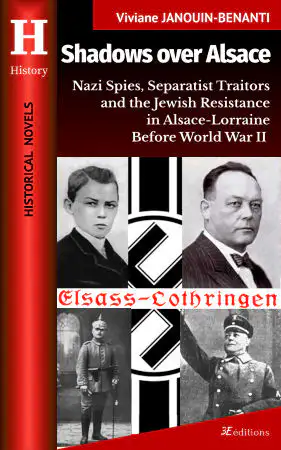
When a Borderland Became the Front Line of an Invisible War
Viviane Janouin-Benanti’s Shadows over Alsace – Nazi Spies, Separatist Traitors, and the Jewish Resistance in Alsace-Lorraine Before World War II begins with an apparently modest event: the birth, in 1878, of Charles Roos, the son of an Alsatian schoolteacher. Nothing in that domestic scene suggests espionage, political fanaticism, antisemitic violence or treason. Yet the author immediately hints that this child will cause more than a few “headaches.” It is an understated opening to a book whose ambitions are anything but small. Over more than four hundred pages, Viviane Janouin-Benanti reconstructs the transformation of Alsace-Lorraine from a disputed border territory into one of the most fascinating—and disturbing—political laboratories of interwar Europe.
The book describes itself as a novel “based on true events,” but it is perhaps best approached as a work of historical fiction or creative nonfiction in which documented people and events are brought to life through scenes and dialogue. Its great achievement is to make a complicated and comparatively little-known chapter of European history intelligible to readers who may know almost nothing about Alsace beyond its picturesque villages, vineyards and Franco-German heritage.
Beneath that familiar landscape, the author discovers a very different Alsace: a battleground of identities, secret money, propaganda networks, informers, political opportunists and men already preparing for the next war while Europe was still recovering from the last one.
A land caught between two nations
To understand the drama, one must first understand Alsace-Lorraine itself. After France’s defeat in the Franco-Prussian War, much of the region was annexed by Germany in 1871. A generation therefore grew up speaking German, attending German schools and, when the First World War came, fighting in German uniforms. Charles Roos is one of them. Decorated with the German Iron Cross during the war, he returns afterward to an Alsace that has become French again. At first, the change causes him no insurmountable difficulty: he speaks French, becomes a French citizen, establishes a business school and even publishes an Alsatian-French dictionary.
Robert Ernst, another central figure, reacts very differently. Born into a household already divided between a Germanophile father and a Francophone mother, he embraces Germany passionately, fights for it during the First World War and chooses German citizenship when Alsace returns to France.
From these individual lives Viviane Janouin-Benanti develops one of the book’s central questions: what happens when nationality changes around people who have not moved at all?
It would have been easy to present the story as a simple conflict between patriotic Frenchmen and German traitors. The book is more interesting than that. In the unsettled years after 1918, genuine grievances exist. Some Alsatians resent French administrative policies, cultural insensitivity and the arrival of officials from the French interior who cannot understand the local language. Trade unions complain; strikes erupt; slogans demand that French officials be sent home.
But grievance creates an opening, and Germany is waiting.
The most chilling passages in the first part of the book show how quickly a regional political cause becomes entangled with foreign manipulation. In 1919, Alsatian separatists meet representatives of the German state, receive money and discuss a manifesto demanding a separate executive for Alsace-Lorraine, exclusion of French officials, exemption from French military service and a local militia. The political struggle is already being subsidized from across the Rhine.
From there the book increasingly resembles a spy novel—except that much of what makes it gripping actually happened.
French counter-espionage penetrates separatist circles. A journalist operating under the name Sam infiltrates meetings while German couriers carry cash, instructions and propaganda into Strasbourg. One memorable sequence follows a courier arriving from Berlin with two heavy suitcases while Sam watches him from a distance. The bags contain two thousand separatist pamphlets, and a police raid follows almost immediately. Yet even this apparent victory is compromised: a mole inside the police has warned important separatist leaders, allowing them to escape.
It is in episodes like this that Shadows over Alsace is at its most entertaining. Political history becomes a succession of meetings in back rooms, coded loyalties, border crossings, surveillance operations and betrayals.
From separatism to Nazism
The book’s second great strength is its depiction of radicalization as a process rather than a sudden conversion.
Robert Ernst becomes increasingly important to German efforts to maintain influence in the lost territories. He learns that nationalism can be advanced not merely through armies but through culture, minority rights, propaganda and carefully cultivated resentment. In one revealing conversation, German strategists explain that demanding an immediate referendum in Alsace-Lorraine would be politically disastrous because Germany might lose it. A more effective tactic is to defend the cultural rights of the German-speaking population and wait for circumstances to change. The goal is explicitly to make Alsace-Lorraine a German stronghold until the right moment arrives.
That long game gives the novel its sense of impending catastrophe. Readers know where European history is going even when many of the characters do not.
By 1927, the separatist movement has become more organized and more radical. Robert Ernst and Karl Roos help establish the Landespartei, the Alsace-Lorraine Independence Party, with Roos at its head. French authorities respond by banning separatist newspapers, raiding homes and arresting movement leaders.
Roos himself proves particularly elusive. He emerges as one of the book’s most intriguing figures because his trajectory contains both calculation and contradiction. He can acknowledge that, despite resentment toward French policy, most Alsatians would probably still choose France if forced to decide. At the same time, he moves ever deeper into German networks and the “psychological war” being waged against French authority.
His 1929 trial is almost theatrical. Supporters pack the courtroom, witnesses are booed, and Roos carefully avoids speaking openly of Germany, insisting that he acts solely for Alsace-Lorraine. His performance succeeds: he is acquitted to a standing ovation.
Ten years later, there will be no such escape.
By then Hitler has transformed Germany, and the ambiguities surrounding Alsatian separatism have become far harder to maintain. During Roos’s 1939 military trial in Nancy, the prosecution produces evidence of military information passed to Germany, testimony concerning his links with Nazi leaders and even a photograph of him in Nazi uniform giving the Hitler salute. He is condemned to death on October 26, 1939, and executed on February 7, 1940.
The long political game has reached its brutal conclusion.
The people who saw the danger coming
Running parallel to the separatist story is another narrative, and ultimately the one that gives Shadows over Alsace its moral center: the awakening of the Jewish community to the threat developing across the Rhine.
One of the most compelling characters is Dr. Joseph Weill. While many French Jews still feel protected by citizenship and republican institutions, Weill reads Mein Kampf and recognizes that Hitler’s antisemitism cannot safely be dismissed as electoral rhetoric. He organizes study sessions so that young Jews can understand Nazi ideology and learn to challenge it.
These scenes sometimes resemble seminars more than conventional novelistic dialogue, but they perform an important function. Viviane Janouin-Benanti wants her reader to understand not only that antisemitism existed, but how it operated: through contradictory stereotypes, pseudo-history, economic resentment and the search for convenient scapegoats. One discussion points out the absurdity of portraying Jews simultaneously as immensely wealthy financiers and impoverished social parasites. Either accusation can be used when hatred has already supplied the conclusion.
As Nazism grows stronger, discussion becomes action.
Jewish youth belonging to Hatikvah and the Éclaireurs Israélites organize self-defense groups when separatist and pro-Nazi gangs begin intimidating Jews on the streets. One confrontation turns into a half-hour fight from which the Jewish youths emerge battered but victorious. More self-defense groups follow under figures including Dr. Robert Lévy-Dreyfus and Henri Lévi.
The reader knows that street fighting will soon become something incomparably darker.
Enzo Sereni, another striking presence, travels through Europe warning audiences about Nazi Germany and helping Jews escape. Later he joins resistance operations, trains with the British-supported Special Operations Executive and parachutes into occupied northern Italy. Captured by the Nazis, he is ultimately executed at Dachau in November 1944.
Henri Lévi’s fate is even more heartbreaking. He and his wife Denise join the Resistance and manufacture false papers. Arrested by the Gestapo while Denise is seven months pregnant, they are sent to Drancy and then Auschwitz with their newborn son, Jean-Michel. All three are murdered in the gas chamber.
Joseph Weill survives and turns warning into rescue. Working with the OSE, the Jewish children’s aid organization, he helps establish escape routes into Switzerland. The book credits the combined efforts of Weill, the OSE and allied rescuers with saving approximately 1,500 children from Auschwitz. He later participates in the rescue operation at Vénissieux that saves 108 children and 500 adults. Hunted by the Gestapo, he escapes to Switzerland, continues his work under the name Jean Valois and returns to France after the war to care for Holocaust survivors.
By this point the meaning of the book’s title has become painfully clear. The shadows over Alsace were visible long before the German tanks arrived.
History with the momentum of a thriller
Viviane Janouin-Benanti’s narrative method has advantages and limitations.
The great advantage is accessibility. Complicated political organizations, ideological alliances and historical personalities are turned into conversations and human encounters. Readers encounter history at café tables, political rallies, police offices, dinner parties and clandestine meetings. Secret financing and geopolitical strategy acquire faces.
The disadvantage is that the sheer number of real people can occasionally become overwhelming. Roos, Ernst, Schall, Hauss, Hueber, Bickler, Weill, Sereni and dozens of lesser figures move through an enormous historical canvas. Readers looking for a traditional novel centered on a handful of fictional protagonists may initially find the structure unusual. Some conversations also carry a conspicuous amount of historical information; characters occasionally speak as much to educate the reader as to one another.
Yet that documentary quality is also part of the book’s individuality. The author is less interested in inventing a perfectly shaped fictional plot than in revealing the connections between events that conventional history often places in separate chapters: Alsatian regionalism, German revisionism, French political mistakes, Hitler’s rise, antisemitism, espionage and Jewish resistance.
And those connections matter.
When German forces finally occupy Strasbourg in June 1940, the separatists imprisoned by France are freed and welcomed as heroes. Fifteen of them sign the Manifesto of Trois-Épis, an explicit pledge of allegiance to Hitler and an appeal for Alsace-Lorraine to be incorporated into the Greater German Reich. The distinction between “autonomy,” separatism and collaboration has collapsed.
What follows is no romantic liberation. Antisemitic persecution begins, synagogues are attacked, economic life is brought under Nazi control, resistance groups form and the Struthof-Natzweiler concentration camp becomes an instrument of terror.
The book then carries many of its real protagonists beyond the war to their final reckoning. Some collaborators are executed, others receive prison sentences, and Robert Ernst—whose ideological journey has accompanied the reader almost from the beginning—is eventually tried after the war. Because he had legally retained German citizenship, the original French charge of treason proves problematic; a later trial sentences him to eight years of hard labor, but time already served permits his immediate release. He dies in Bavaria in 1980.
There is something unsettlingly appropriate about such an ending. History does not provide the neat justice of fiction.
Why this book deserves to be read
The deepest subject of Shadows over Alsace is not simply espionage, Nazism or even Alsace. It is the exploitation of legitimate grievance by people pursuing a very different agenda.
Viviane Janouin-Benanti shows how dissatisfaction can be cultivated, financed, redirected and radicalized. She also shows how democratic governments can worsen a problem by failing to understand local identity. At the same time, the book refuses the comforting idea that every separatist was merely an innocent regionalist. For some, German money, German intelligence and eventually National Socialism were not accidental associations but central elements of their political activity.
Against them stand people such as Joseph Weill, Enzo Sereni, Henri and Denise Lévi and the young Jewish self-defense groups—people who grasp that there are moments when merely disapproving of extremism is insufficient.
That contrast gives the book much of its emotional power.
Shadows over Alsace will appeal to readers of political history, espionage, World War II literature and historical fiction, but perhaps especially to those who enjoy discovering the history hidden behind familiar events. Most people know that Hitler invaded France in 1940. Far fewer know about the years of political warfare, propaganda, clandestine financing and ideological recruitment that preceded German soldiers crossing the Rhine.
By telling that story through the lives of the people who participated in it, resisted it or became its victims, Viviane Janouin-Benanti turns a regional history into something larger: a study of how democracies are undermined before anyone declares war, how fanaticism becomes respectable one compromise at a time, and how courage sometimes begins simply with the willingness to recognize danger before everyone else does.
The result is dense, disturbing and frequently gripping. It is not merely a book about what happened to Alsace-Lorraine between two world wars. It is a book about the years during which the next war was already being fought—in newspapers, political organizations, secret meetings, classrooms and streets—while much of Europe still believed itself to be at peace.
That is what makes Shadows over Alsace so worth reading. Its most compelling revelation is also its most sobering one: history’s great catastrophes rarely begin on the day armies cross a border. Long before the soldiers arrive, the shadows are already there.
Where to buy the book:
Amazon
• Hardcover, ISBN: 978-2-37885-161-3
Price: $26.00
• Paperback, ISBN: 978-2-37885-160-6
Price: $17.00
• Kindle eBook, 978-2-37885-159-0
Price: $4.99
ebook (epub)
• Kobo
Price: $4.99