A Bordeaux Housewife’s Murderous Secret
by Viviane Janouin-Benanti
Translated by Elizabeth Blood
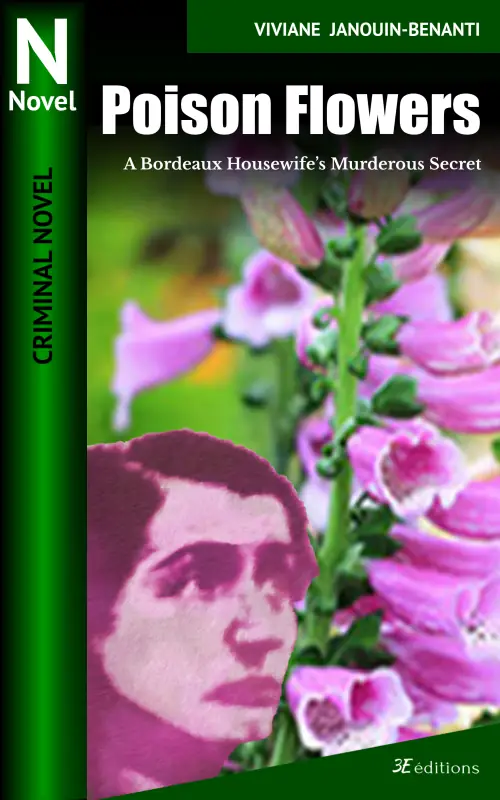
Here’s a crime novel that blooms slowly—and lethally. Set in interwar Bordeaux and built from a true case, Poison Flowers: A Bordeaux Housewife’s Murderous Secret follows Gabrielle Mairiné, a well-liked café keeper, attentive mother, and—eventually—the quiet architect of two near-perfect murders. Viviane Janouin-Benanti’s book (in Elizabeth Blood’s supple English translation) takes its time, steeping you in politics, daily routines, and family resentments until a cup of anise tea becomes the most terrifying object in the room. The result is a richly atmospheric, morally provocative read that fans of historical fiction and true crime will devour. (It’s explicitly “based on true events,” with names changed to protect descendants. )
The hook: a housewife, a city, and a poison that leaves almost no trace
Gabrielle’s story begins in 1922, at a wedding that already feels like an argument. She marries Laurent, a devoted socialist and railroad worker, despite her bourgeois mother Adèle’s disdain for his modest means. The family is still vibrating with the aftershocks of World War I—her father, André, is a shell of himself, drifting between silence and fevered recollection, the Spanish flu having only deepened the psychic crater the trenches left behind.
Bordeaux itself becomes a character: the Saint-Michel spire looming over Rue des Faures, the Pont de Pierre tying riverbanks together, the little café at 85 Rue des Faures where Gabrielle pours wine, gossip, and cheer. The book’s photo album grounds the fiction in place—there’s even a snapshot of the café’s exact site—reminding you this isn’t just an author’s invention.
Viviane Janouin-Benanti stitches Gabrielle’s private life to the public mood: postwar politics (Jaurès’s assassination, Blum’s rise), socialist meetings, and the noisy, hopeful talk of progress that thrums through her wedding feast. But the seeds of the novel’s title are planted earlier and deeper. As a teenager, Gabrielle becomes fascinated by poisons—first in a school lesson about the autumn crocus (colchicine) and, chillingly, in a front-row seat at the sensational trial of Marie Lasvand, accused of poisoning her husband with Fowler’s solution (arsenic). That fascination becomes a reading habit. Years later she devours press coverage of Violette Nozière—the young Parisian who poisoned her parents and whose sentence was eventually softened—absorbing a dangerous lesson about public sympathy and female offenders.
The book’s central irony is that Gabrielle is neither an ideologue nor a melodramatic femme fatale. She’s practical, secretive, a “good girl” who craves freedom more than romance. The author renders her interiority with unnerving calm: a woman who watches, learns, and then acts.
The crimes (and why they work so disturbingly well on the page)
Two things turn this quiet Bordeaux life toxic: knowledge and opportunity. From a pharmacy assistant lover, Gabrielle borrows a toxicology manual and studies it like scripture. She learns what a pathologist might find—and just as crucially, what he won’t. Her eye falls on digitalis, a cardiac glycoside derived from foxglove: slow-acting, insidious, hard to detect in a corpse unless the dose is massive. It won’t linger in the liver or kidneys; to catch it, a doctor would need the victim’s vomit while they’re still alive.
By the time Gabrielle meets Abdous Amar, a charismatic soldier, the chance to use that knowledge arrives. When Adèle discovers the affair and gives her daughter seven days to end it—or she’ll tell Laurent—Gabrielle makes a decision that’s as methodical as it is monstrous. She settles on a delivery system that feels maternal and harmless: anise tea, served in loving doses that hide the bitter medicine.
Adèle dies. It looks natural. A harried doctor signs the certificate. Gabrielle’s calculation is proved correct: no one suspects digitalis, and no one was called while the vomiting might have betrayed it. Only a neighbor’s curiosity and Abdous’s subsequent blackmail (he extracts a savings book and 45,000 francs in equities) hint at the rot beneath the surface. The confrontation leads to Abdous’s arrest—but when he returns the money, the charges are dropped, and Gabrielle slips free again.
Enter lover number two: Édouard Camou, a manipulative boarder who installs himself not just in the spare room above the café but in Gabrielle’s bed and plans. Soon, Laurent—honest, hardworking, and too often away on the railroad—falls violently ill. He vomits incessantly, and when his mother tries to take him away he reportedly begs, “Maman, get me out of here. She’s poisoning me.” No doctor is summoned until after he dies; a polite physician notes how the bedroom smelled of lavender and looked so peaceful that he accepted the widow’s “heart attack” narrative at face value.
This is where Viviane Janouin-Benanti’s craft bites. She never sensationalizes the killings. Instead she puts us at kitchen-table height, in the ordinary light of afternoon, where love curdles into convenience and a teacup turns lethal. The horror is domestic. The method—patient, “invisible,” almost bureaucratic—feels truer, and uglier, than a spree of spectacular violence.
The investigation and trial: a true-crime engine that hums quietly
An anonymous letter finally jolts the police: a tip about the “happy widow” who’s celebrating with her lover and a death that looked like poisoning, not fate. The Chief arrests Gabrielle and Camou while they’re still laughing in each other’s arms. (She’s sent to Bordeaux’s Fort du Hâ prison, whose forbidding silhouette appears in the book’s photo album.)
The courtroom sections are among the most gripping—and most maddening. Witnesses line up to praise Laurent as “the best of men” and to denounce Gabrielle’s adultery, a moral register the prosecutor smartly plays. More damning are the medical and forensic testimonies: the pathologist explains why digitalis is nearly impossible to confirm post-mortem; the family doctor admits he was exhausted and simply didn’t imagine poisoning; another physician describes the lavender-scented room and his own credulousness.
The prosecutor’s summation is devastating in its cold logic. Two deaths, both by the same careful method; two refusals to call a doctor during the crucial hours when vomit could be tested; two cups of that “hideous anise tea.” He argues that Gabrielle didn’t kill for money or escape but “for pleasure”—a chilling claim that the narrative never answers definitively but that lingers like a bitter aftertaste.
The defense counters with victimhood and coercion. Gabrielle casts the men around her—Abdous and Camou—as puppet-masters who pushed her into murder; she even invokes Violette Nozière as a precedent for clemency. But Abdous—respectful, even wounded—insists “she’s the one who wanted to kill,” and his testimony about anise tea and “little pills” doesn’t help.
A verdict is inevitable. Gabrielle is sentenced to death; Camou and Amar receive twenty years each. She is guillotined on January 8, 1941—in wartime, under a gray sky of rationing and fear. The book records her last, baffled attempt to treat the moment as a monetary inconvenience (“Go to the clerk’s office—that’s where all my money is”), and her ferocious struggle when she understands where she’s actually going.
Why it works: character, context, and a poisoner’s cool precision
Viviane Janouin-Benanti writes in a clean, reportorial line—but she’s sly about how she layers it. Each early page that seems purely historical turns out to be plot. The chemistry lesson on autumn crocus foreshadows a mind learning that beauty can be lethal. The Lasvand and Nozière cases don’t decorate the background; they shape Gabrielle’s imagination of what’s possible and what she might get away with. Even reading Mauriac’s Thérèse Desqueyroux becomes an accelerant: Gabrielle treats the novel’s dismissed charges as confirmation that she’s chosen the right poison and the right era to use it.
The book’s other strength is its moral ambiguity. It’s easy to loathe Gabrielle by the end, but Viviane Janouin-Benanti first teaches you how to see her: a young woman raised in a house of silenced men and sharp-tongued women; a city where public ideals glow and private rooms grow stale; a marriage whose logistics (Laurent is gone for long stretches; the café is hers to run) open the door to temptation and then to crime. Even as the evidence stacks up—and the author never soft-pedals it—you remember that Gabrielle learned patience in a world that demanded patience from her and that she weaponized the domesticity that confined her. It’s not sympathy; it’s comprehension. That’s harder, and braver.
The translation helps. Elizabeth Blood’s English is transparent but alert to register—political argument sounds like political argument; kitchen talk sounds like kitchen talk; the courtroom oratory winds up the rhetoric without tipping into purple. Small cultural markers (street names, cafés, police stations) remain resolutely French without ever turning opaque. The edition itself is recent (3E éditions, 2025), and the back matter situates Viviane Janouin-Benanti as a writer of creative nonfiction grounded in legal and criminological research—exactly what this book feels like: novelistic pacing atop a scaffold of fact.
Will you enjoy it?
If you like your historical crime with texture—streets you can walk, posters on a city wall, little ledger entries that come back like ghosts—you’re in luck. You get Bordeaux as lived place (Rue des Faures, Saint-Michel, the Pont de Pierre), a procedural that respects how real investigations hinge on petty gossip and anonymous letters, and a courtroom drama that takes science seriously enough to explain precisely why this killer almost got away with it.
If you’re drawn to the psychology of crime—how an ordinary person rehearses their ethics until they can’t hear them anymore—Poison Flowers will keep you turning pages. And if you’ve ever been fascinated (or disturbed) by the way literature and journalism can teach crime (Thérèse Desqueyroux, the Lasvand and Nozière cases), this book reads like a cautionary tale about stories as primers: what we absorb, we sometimes enact.
Any quibbles?
Only small ones. Because the case is so strong, some late sections tilt a hair toward prosecutorial certainty—especially in the closing argument’s assertion that Gabrielle kills “for pleasure.” The novel (wisely) doesn’t try to sit inside that claim; it lets the court say it. Whether you agree is part of the book’s after-discussion, not its answer.
Bottom line
Viviane Janouin-Benanti doesn’t show you a monster; she shows you a method—how knowledge, grievance, and opportunity can mix into something as deceptively pretty as a poison flower. The narrative is intimate without being lurid, researched without being pedantic, and paced to match the patient timing of the crime itself. By the time the blade falls at Fort du Hâ, you’ll feel you’ve walked every step from the school lab to the café counter to the courtroom bench—and you’ll eye your next digestive tea with more caution than you’d like to admit. If you’re after a smart, unsettling true-crime novel that doubles as a portrait of a city and a century-old mindset, Poison Flowers is a must-read.
Where to buy the book:
Price: $22.00
Price: $13.00
Price: $4.99