Fritz Haarmann
by Viviane Janouin-Benanti
Translated by Elizabeth Blood
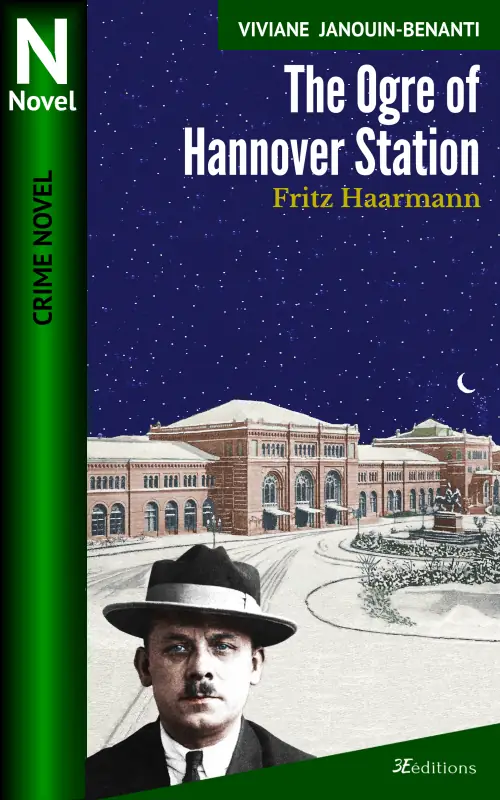
Here’s the short version first: if you like true-crime that reads like a novel, if you’re curious about how a city’s hunger, chaos, and indifference can incubate a predator, and if you prefer authors who focus more on people than gore, then Viviane Janouin-Benanti’s The Ogre of Hannover Station: Fritz Haarmann is absolutely worth your time. In clear, swift chapters, she reconstructs the life and crimes of Germany’s most infamous station-stalker and the investigation that finally stopped him—without wallowing in sensationalism. The English edition from 3E éditions (2024), translated by Elizabeth Blood, is crisp and accessible, and it carries a thrum of dread from the first scene to the last.
What it’s about (and why it grips you)
Viviane Janouin-Benanti opens not with a gruesome tableau but with a boy at a table, embroidering alongside his mother; from the start she frames Fritz Haarmann within a household where devotion and dysfunction coil together. The portrait is unsettling: a son cherished to the point of complicity, a father he’s taught to despise, and a childhood already bending toward predation as the cellar of the apartment building becomes his private hunting ground. The scenes are lean and sober, designed to unsettle because they feel ordinary—thin walls, neighbors passing in the stairwell, a mother who looks the other way.
From there the canvas widens to Hannover between 1918 and 1924, a city gutted by war and inflation. Police resources are frayed, the black market flourishes, and missing-person slips pile up on a weary chief’s desk. Viviane Janouin-Benanti keeps returning to the train station—Hannover’s beating, seedy heart—where runaways, job-seekers, and boys escaping violent homes drift through the waiting room and into Haarmann’s path. That recurring setting isn’t just atmospheric; it’s structural. Whole swaths of the case orbit that concourse, and the book uses it like a stage on which similar scenes play out with chilling variation.
The book’s middle third covers the years when Haarmann perfects his methods and his cover. Viviane Janouin-Benanti shows how he insinuated himself as a small-time dealer and police informant, cultivated a clean, almost official bearing, and befriended people who could inadvertently help him move clothes and other property taken from victims. Key vignettes—like the hairdresser at the station who watches Haarmann glide past a document check, or two sex workers carrying a suspicious “cut of meat” to the police—convey a pattern: witnesses sense something is wrong, but institutions shrug; by the time anyone acts, another boy is gone.
Viviane Janouin-Benanti is careful with victims, too. She sketches family dynamics in quick strokes—a strict father, a dutiful student bored by his own perfection, a boy seduced by the promise of hot chocolate after a rainstorm—so that when a life breaks off the page, you feel its shape. These are not mere names on a list. In one of the book’s most quietly devastating sequences, she tracks the Kayser case from the casual cruelty of classmates plying him with beer to the practiced ease with which Haarmann interposes himself as a “familiar” adult; the aftermath ripples through a shopkeeper, a restaurant owner, and a police chief who is tired and much too late.
Monsters, enablers, and an “us” that failed
This is not just a killer’s chronicle; it is a study in complicity—private, commercial, and institutional. Haarmann’s lover, the younger Hans Grans, is a constant, corrosive presence. The book doesn’t overtheorize their bond; instead it gives you moments: Grans angling for a victim’s suit, playing Cupid when it suits him, recoiling only when the bodies threaten his own comfort, and, later, trying to save himself in court as Haarmann oscillates between protection and accusation. It’s a relationship that is pitiful, mercenary, and—at the trial—fatally performative.
The police are not caricatured as fools; they are shown as outmatched, sometimes compromised, and often blinkered. Chief Retz, peppered through the narrative, is a study in fatigue: he hears the rumors, stacks the files, admires the green hat “gift” on his peg, and tells himself the station is merely where runaways board trains. In one darkly comic-and-awful beat, he ferries a wrapped hunk of “meat” to the medical examiner, who eyes it and dismisses it as pork; by the time the river is dragged, there’s no room for denial left. The institutional failure is incremental and human—exactly what makes it feel so contemporary.
Haarmann himself is never mystified into a gothic cipher. What emerges is a petty, manipulative man with the gift of reading a room and the terror of losing control. Viviane Janouin-Benanti threads recurring motifs—his lifelong dread of the asylum, his sudden recitations from the Bible after a killing, his fussy pride in clothes and neatness—to show a personality that is at once banal and chilling. The book is frank about sexual violence, but the author keeps her camera above the line of the unspeakable; she is more interested in the predator’s choreography—how he chooses, how he lies, what he fears—than in lingering over wounds. It’s an ethical choice that gives the story weight rather than shine.
The investigation that finally bit down
When the narrative turns from rumor to evidence, Viviane Janouin-Benanti tightens the screws with procedural detail. The arrest in June 1924 feels like a dam giving way: officers fan out to search his two addresses; families of missing boys are summoned to identify clothing laid out in grim profusion; a one-way mirror confrontation yields a witness who remembers the “police officer” who lured his friend away. The river dredging sequence, which uncovers more than 1,500 bones from boys aged roughly seven to twenty-five, arrives like a collective reckoning—not just with what Haarmann has done, but with everything the city and its guardians ignored.
The trial plays as a grotesque theater. Viviane Janouin-Benanti lets the scene speak: the cigars and quips, the courtroom bravado, the self-mythologizing number (“let’s say fifty, or more if you want”), the repeated plea for the guillotine rather than the asylum. Around him, exhibits pile up—clothes, toolboxes—and families testify while the accused preens and postures. The author doesn’t editorialize much; the horror is in the mismatch between the gravity of loss and the clownish self-regard at the dock. The verdict is death—both for Haarmann and, initially, for Grans. (Grans’s sentence is later reduced on appeal.) Haarmann is executed the following spring.
How it’s told (and why it works)
Viviane Janouin-Benanti calls these books “novels based on true events,” and the approach here will feel familiar to readers of narrative nonfiction: short, cinematic scenes; a rotation of viewpoints (parents, neighbors, police, the killer); and a firm grounding in documented fact. She resists two common traps of the genre—the clinical catalogue and the lurid blow-by-blow—opting instead for moral and psychological texture. Even in a paragraph or two, a family becomes more than a victim’s surname; even a minor neighbor acquires a habit, a limp, a reason for looking the other way. That restraint in tone—“sensitive and restrained,” as one early appraisal in the book notes—does not blunt the horror; it sharpens it.
Another strength is the way she uses repetition as structure. The station: again. A boy alone in the rain: again. A parent at a desk opposite Chief Retz: again. Far from monotonous, the cadence drives home how routine and predictable the predator’s pattern became—and how institutionally convenient it was to call each new disappearance a runaway. When the screws finally turn (the search, the clothes, the river), the reader feels the release not as triumph but as an indictment.
The book’s architecture includes a photo album at the end—Hannover station, the Leine, the Rote Reihe apartment, even the infamous cupboard—plus snapshots of figures like Grans and images from the trial. It’s sobering, not salacious, and it anchors the reconstruction in places you can picture. The inclusion underlines that this isn’t a gothic fable; it happened in rooms, stairwells, courtyards, and a city river most residents had stopped really seeing.
Translation notes
Elizabeth Blood’s translation is invisible in the best way. Dialogue beats are brisk and idiomatic; chapter endings land with a clean snap; there’s a steady register that never lapses into either archaisms or modern slang that would jar the period mood. Given how often the prose skirts charged material, that steadiness matters. The back matter notes Blood’s background in French literature, and you can feel the academic discipline in the economy of choices—never fussy, never flat.
The bigger picture
Because the book stays close to scene and character, its social argument arises indirectly. Yet it is unmistakable. Viviane Janouin-Benanti shows how a city’s miseries—hunger, overcrowding, postwar demoralization—made boys vulnerable and officials deferential to anyone who looked like order. She is frank about class: early disappearances from poor families largely land with a thud in the station’s echo chamber; attention sharpens when sons of the well-to-do vanish. She is frank, too, about sexuality: the point is not that Haarmann is homosexual; it’s the way he weaponizes sex, trust, and class markers (a new suit, a book satchel, a promise of a warm drink) in a society that polices desire and looks away from exploitation. The net result is a story that’s historical but uncomfortably current.
Will you want to read it?
That depends on your threshold. The author promises not to dwell on the sordid, and she keeps that promise, but she does not euphemize the crimes or their aftermath. Readers sensitive to depictions of violence against minors should know that while scenes are written with restraint, they are still harrowing. The payoff is understanding: you come away seeing how a predator’s ordinary mask can be made, how institutions can be softened by gifts and small favors, and how a city can learn to hear the station’s hum as background noise until the river itself starts talking.
For readers of Erik Larson-style nonfiction; for fans of Emmanuel Carrère’s cool, penetrating eye; for anyone interested in the porous borders between novel and reportage—this is prime territory. The pacing is fast (think two or three pages per scene), the cast vivid even in cameo, and the moral questions—about responsibility, about the limits of “simple-mindedness” as a shield, about how easily bureaucracies can be gaslit—linger long after the final chapter.
A few standout moments (no spoilers beyond the history)
- The “pork” episode. Two women drop a bundle on the police chief’s desk, and the medical examiner waves it off. It’s a bleakly comic set piece that lands twice—first as denial, and later as tragic foreshadowing.
- The hat on the peg. Retz’s bright green gift—an almost silly detail—becomes a moral weight he keeps sidestepping. It’s a symbol of how small courtesies can blunt suspicion.
- The river sequence. The order to probe the Leine inch by inch is as cinematic as anything in the book, and the number of bones recovered is staggering. It’s the moment the city can no longer lie to itself.
- The trial’s theater. Cigars, Bible verses, and the killer’s performative bravado set against mothers who faint at the sight of a monogrammed suit. The mismatch is sickening and unforgettable.
Verdict
The Ogre of Hannover Station is both gripping and careful, an unusually humane entry in a genre that often confuses cruelty with candor. Viviane Janouin-Benanti’s gift is perspective: she sees the killer clearly, but she refuses to let him eclipse the parents who search, the boys who make one small wrong choice in a dark week, and the officials who find a hundred reasons not to act. The final chapters—arrest, river, trial, execution—deliver the expected closure; the closing “Photo Album” and notes on the author’s creative-nonfiction method remind you this is history, not myth. You close the book not with prurient satisfaction, but with a sharper sense of how such a story becomes possible, and what it takes to stop it. Highly recommended, with the caveat that its restraint is moral, not anesthetic: the pain is real, and the author honors it.
Publication details: 3E éditions, 2024; translated by Elizabeth Blood; ISBN 978-2-37885-104-0.
Where to buy the book:
Price: $25.00
Price: $16.00
Price: $4.99
Price: $4.99
Price: $4.99
Price: $4.99