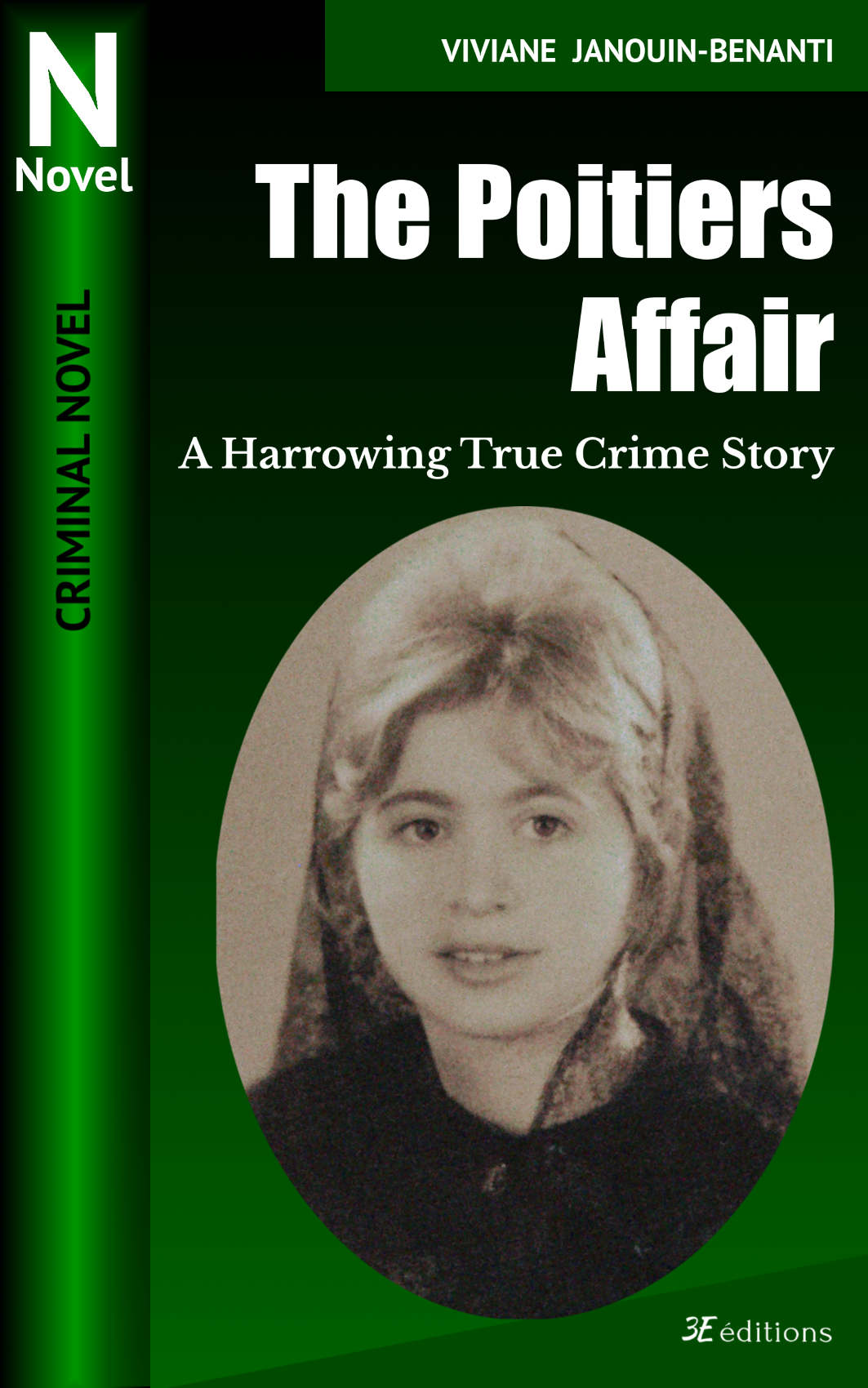
A Harrowing True Crime Story
Viviane Janouin-Benanti
Translated into English by Elizabeth Blood
Introduction
In The Poitiers Affair: A Harrowing True Crime Story, Viviane Janouin-Benanti revives one of the most chilling and little-known true crime cases in 19th-century France: the secret imprisonment of Blanche Monnier, a young woman from the high society of Poitiers, held captive for nearly 25 years by her own mother and brother in a sealed, windowless room.
The story, told with restraint, documentary precision, and respect for its central figure, is not only shocking for the nature of the crime itself, but for the deeper question it raises: how could such horror take place, undetected, in the heart of a respectable and powerful family?
The True Story Behind the Book
Blanche Monnier was born into a wealthy and conservative bourgeois family in Poitiers, France. Her father, Émile Monnier, was a former dean of the Faculty of Letters and a widely respected man. Her mother, Louise Monnier (née de Marcillat), came from aristocratic roots. Blanche was raised in privilege, educated, well-read, and considered beautiful and independent in thought.
Around 1876, Blanche, at age 25, fell in love with an older man – a republican lawyer – and expressed her desire to marry him. Her mother, a strict monarchist, and her brother Marcel, a career bureaucrat, were both outraged by this socially and politically unacceptable match.
When Blanche persisted in her desire to marry outside the expectations of class and politics, her family took an unthinkable decision: they locked her away in a shuttered room in the attic of their house, and kept her there for 24 years.
A Life in Darkness
From 1876 to 1901, Blanche lived in a filthy, vermin-infested room. The window was boarded up. The door was locked with multiple bolts. She slept on a rotting straw mattress. She was denied sunlight, hygiene, human company, and contact with the outside world. Food was brought to her irregularly; she was rarely washed or clothed.
What’s even more horrifying is that this happened in the middle of a respectable town house – not a remote mansion, not a dungeon, but a building in a well-populated street in Poitiers. Servants worked in the house. Neighbors passed by. Her brother Marcel rose through the ranks of the French civil service. Her mother continued to host visitors, attend mass, and maintain the family’s public image.
Blanche was literally hidden in plain sight – and no one intervened.
Discovery and Rescue
Blanche’s liberation only came by accident. In 1901, the Paris Attorney General received an anonymous letter stating that a woman was being held captive in the Monnier house in Poitiers. The letter was written in simple language, unsigned, but detailed enough to be taken seriously.
Police were sent to investigate. When they arrived at the Monnier home, they were told nothing was wrong. But during the search, they forced open the door to the upstairs room – and discovered Blanche.
She was malnourished, weighing just 25 kilos (55 pounds). Her bones were visible through her skin. The room was covered in excrement, rot, insects, and filth. She had not seen daylight in 24 years.
The police officers were so shocked by the smell and sight that one immediately vomited. Photographs were taken of the room as it had been found, and those images later circulated widely in the press, horrifying the public.
The Aftermath
Blanche was hospitalized and slowly began to recover. Physically fragile, psychologically altered, and socially disconnected, she nonetheless showed signs of lucidity and intelligence – a survivor, not a broken shell.
Her mother, Louise Monnier, was arrested and charged with illegal detention and abuse. But before she could face trial, she died just 15 days after Blanche’s rescue – reportedly from heart failure, though some believed the public scandal hastened her death.
Blanche’s brother, Marcel Monnier, was brought to trial. Though he claimed he had done nothing illegal – insisting his sister “was mad” and had to be isolated – the public and the court were less forgiving. He was initially convicted and sentenced to 15 months in prison, though on appeal, his sentence was overturned due to legal technicalities.
Still, the damage was done: the Monnier name became synonymous with cruelty and secrecy.
Blanche, for her part, spent the rest of her life under medical supervision in a care facility. She died in 1913, twelve years after her release, at the age of 64.
How the Book Tells the Story
Viviane Janouin-Benanti does not sensationalize. Her narrative style is clear, direct, and rooted in historical records. She reconstructs events chronologically, from Blanche’s early life and personality to the family’s ideology and control, the crime’s execution, and the final unraveling. Using archival documents, witness testimony, trial records, and press clippings, she brings the facts to the surface with care.
What emerges is not just a timeline, but a portrait of a family obsessed with image, control, and social status – willing to erase a daughter rather than allow her to make her own choices.
Themes
1. Female Autonomy as Threat
Blanche’s only “crime” was to want to marry a man her family deemed unworthy. Her punishment – total sequestration – reveals how women’s independence was seen as a direct threat to patriarchal and class-based structures. The Monniers would rather destroy Blanche’s life than risk a marriage that might “dishonor” the family.
This is not simply a case of madness – it is social control taken to pathological extremes.
2. Complicity Through Silence
Perhaps the most haunting aspect of the affair is how many people must have known – or at least suspected – that something was wrong. The house was occupied. Servants came and went. Blanche was not in hiding underground, but upstairs. The silence of neighbors, employees, and even church authorities reflects a broader social sickness: the desire to preserve reputation at any cost.
3. The Fragility of Justice
Though Blanche was eventually rescued and her brother charged, justice was not fully served. Marcel never spent a day in prison. The mother died before trial. The law, constrained by definitions of mental health and familial authority, failed to address the full horror of what had been done.
4. Survival and the Human Spirit
Even more astonishing than the crime is Blanche’s survival. Though physically wrecked, she never lost her mind. She remembered names, events, books. Her recovery, though partial, shows the resilience of the human mind under conditions most people could not endure for a week, let alone two decades.
Structure and Sources
The book is divided into clear chapters, moving steadily from Blanche’s early years to the discovery of the crime, the legal proceedings, and the public reaction. Each stage is supported by:
- Official medical reports
- Police documents
- Witness testimony
- Letters
- Contemporary newspaper coverage
Photos of the crime scene are also discussed, and their cultural impact is noted. The documentation gives the story weight and credibility.
Historical Context
The story unfolds in the late 19th century – a time when France was struggling between monarchist and republican factions, when mental health was poorly understood, and when women were legally subordinate to male relatives. Blanche’s confinement reflects all three pressures: political ideology, legal impotence, and patriarchal obsession.
Viviane Janouin-Benanti wisely situates the crime within this broader cultural and legal framework, making it more than an isolated horror – it becomes a symbol of systemic failure.
Conclusion
The Poitiers Affair is not just a shocking true crime story – it is a meticulously researched indictment of family cruelty, societal complicity, and institutional apathy. Viviane Janouin-Benanti brings Blanche Monnier’s story to light not with dramatic flair, but with compassion, discipline, and a determination to honor the truth. This is a must-read for those interested in women’s history, criminal justice, and the psychology of power. It is a disturbing yet necessary reminder that the worst crimes often happen in silence – and that telling the truth, even a century later, is an act of justice, raveled not by violence, but by the cold machinery of power.
Where to buy the book:
- Hardcover, ISBN: 978-2-37885-060-9
Price: $21.00
- Paperback, ISBN: 978-2-37885-059-3
Price: $12.00
- Kindle eBook, ISBN: 978-2-37885-058-6
Price: $4.99
- eBook, ISBN: 978-2-37885-056-2
Price: $4.99
- eBook, ISBN: 978-2-37885-056-2
Price: $4.99
- eBook, ISBN: 978-2-37885-056-2
Price: $4.99
Leave a Reply