Kings and Prophets (930–400 BC)
by Serge Janouin-Benanti
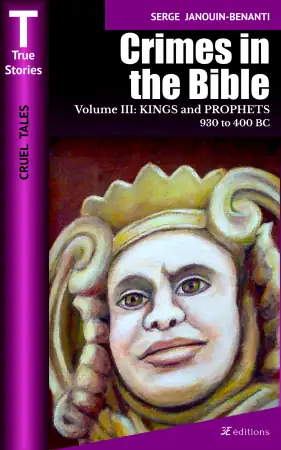
A gripping journey through power, prophecy, and the violence of the ancient world
What happens when murder can be justified as obedience to God, when a prophecy becomes a political weapon, and when the people entrusted with defending justice are themselves capable of terrible crimes? These are the unsettling questions at the heart of Crimes in the Bible – Volume III: Kings and Prophets, the ambitious third installment in Serge Janouin-Benanti’s exploration of the darker stories of Scripture. Spanning more than five centuries, from the breakup of Solomon’s kingdom to the reconstruction of the Jewish community under Persian rule, it is a dramatic panorama of ambition, betrayal, warfare, religious zeal, and survival. Its fascination lies not simply in the brutality of the events it recounts, but in the uncomfortable moral questions it leaves behind.
This is not a conventional novel following one hero from beginning to end. It is a succession of interconnected historical narratives, drawn from biblical accounts and brought to life through imagined conversations, psychological portraits, and lively storytelling. Kings rise and fall, prophets compete to speak for Yahweh, women struggle for influence or survival, and ordinary people pay for decisions made far above them. The author’s distinctive achievement is to make a potentially bewildering sequence of reigns and dynasties feel like an unfolding drama whose central character is power itself.
The story begins around 930 BC, with the death of Solomon and the division of his realm. To the north stands Israel, larger, more populous, and commercially promising but fragmented by tribal loyalties. To the south lies Judah, smaller and poorer, yet united around Jerusalem, the Temple, and the dynasty of David. At first, the division appears mainly political. Soon, however, it becomes a religious struggle. Jeroboam, the northern king, fears that pilgrims traveling to Jerusalem will eventually transfer their loyalty to his rival Rehoboam. He establishes sanctuaries at Bethel and Dan, installs golden calves as symbols of worship, and creates a new priesthood. In Serge Janouin-Benanti’s telling, a theological controversy emerges from a very practical anxiety: how does a ruler keep his people—and their offerings—at home?
That opening establishes one of the book’s most compelling ideas: religious conviction and political calculation are rarely easy to disentangle. The story of the elderly prophet Thachah and the younger Yedo turns this tension into an intimate tragedy. Thachah, desperate to recover his lost sense of divine inspiration, deceives a genuinely devout visitor into disobeying a command. When punishment follows, the real instigator is left to contemplate his responsibility. The episode is brief compared with the great wars to come, but it is among the most disturbing. It asks whether sincerity excuses error, whether a lie can be forgiven because it sprang from longing, and why the deceived may suffer more than the deceiver.
The author can also be unexpectedly funny. When Pharaoh Shoshenq threatens the two kingdoms, Jeroboam engineers a remarkable bargain: rather than pay Egypt from his own depleted treasury, he manipulates events so that Jerusalem’s treasures are surrendered to cover the demands imposed on both rivals. The sequence plays almost like an ancient political confidence trick. Yet Jeroboam discovers that the pharaoh is a better strategist still. Such reversals keep the early chapters moving and prevent the long historical chronology from becoming merely a succession of dates.
As the northern monarchy changes hands, the narrative darkens. Nadab is assassinated, Baasha destroys his predecessor’s family, and Zimri’s brief seizure of power ends in catastrophe. Dynastic legitimacy often lasts only until someone produces a sword. The author repeatedly reveals the machinery behind these killings: military frustration, family rivalry, taxation, greed, and fear of potential heirs. Prophecy is frequently invoked afterward to turn a convenient murder into an apparently necessary act. In this world, the announcement of divine judgment can serve as both threat and retrospective alibi.
The reign of Ahab and the formidable presence of Jezebel form one of the book’s richest sections. Ahab is not presented as a simple monster. He is an able administrator and diplomat who strengthens Israel, promotes trade, builds alliances, and allows religious pluralism. Yet his virtues do not protect him from weakness. When Naboth refuses to sell an ancestral vineyard, Ahab retreats into childish disappointment. Jezebel responds with chilling efficiency. Understanding how the law treats blasphemy and the testimony of witnesses, she arranges a fraudulent accusation and a judicial execution. A modest plot of land becomes the motive for murder; legal procedure becomes its instrument. It is a devastating illustration of how a system created to establish justice can be twisted to destroy an innocent man.
Jezebel’s opponents are no less worthy of scrutiny. Elijah, courageous and utterly convinced of his mission, confronts the prophets of Baal in the spectacular contest on Mount Carmel. The miracle is followed by the killing of hundreds of defeated priests. The scene exposes the troubling proximity between faith and violence: the victor’s certainty leaves no room for mercy. His successor Elisha is equally disconcerting: the prophet who heals the sick and performs extraordinary miracles also curses children for mocking his baldness, with horrifying consequences. The subsequent rise of Jehu takes this logic to almost unbearable extremes. He destroys Ahab’s descendants, has political rivals slaughtered, and deceives the worshippers of Baal into gathering for a massacre. The recurring question is not simply who commits a crime, but who has the authority to call it a crime when the perpetrator claims divine approval.
The violence does not remain confined to Israel. In Judah, Queen Athaliah’s bid for the throne leads her to order the extermination of David’s descendants; one child, Joash, survives in secrecy, creating a suspenseful story of palace intrigue and a threatened dynasty. Later, the fate of Joash and his assassins prompts a surprisingly absorbing discussion of criminal responsibility. Should children be punished for the sins of their parents? Through a spirited debate among priests, Serge Janouin-Benanti turns a question of biblical law into a recognizable issue of justice. Amid so much brutality, the insistence that each person must answer for their own actions feels like a moment of genuine moral progress.
Not all prophets in this book demand blood. Amos condemns a society in which the wealthy feast while the poor are exploited, justice is bought, and the vulnerable are abandoned. Hosea, whose troubled marriage informs his message, imagines divine love in terms of fidelity, estrangement, and forgiveness. These voices deepen the portrait of prophecy. The prophets are not a single-minded chorus but figures with conflicting priorities: some defend the powerless, some announce destruction, some manipulate rulers, and some are manipulated in turn. Their rivalry supplies much of the book’s intellectual energy.
Meanwhile, a greater danger approaches from beyond the rival kingdoms. Assyria’s growing power changes the scale of the conflict. The battles and coups that once seemed decisive become small episodes within the ambitions of an empire. Tribute, military intervention, deportation, and the resettlement of conquered peoples slowly undermine Israel. The fall of Samaria and the disappearance of the northern kingdom mark a turning point. What began as a contest between two heirs of Solomon becomes the struggle of a people to preserve their identity under foreign rule.
Judah survives longer, but its position is scarcely more secure. Hezekiah’s fierce campaign against idols and his disastrous challenge to Assyria expose the risks of mistaking a religious mission for a workable military strategy. Against this atmosphere of fear, the tale of Judith offers a change of rhythm. With Bethulia threatened by a siege and its inhabitants weakened by thirst, a woman decides to confront the enemy commander Holofernes. Her courage, intelligence, and ability to turn his assumptions against him make this one of the volume’s most vivid episodes. It is both a thriller of calculated deception and a portrait of a woman acting decisively where armed men have begun to lose hope.
Other rulers reveal contradictions that resist easy judgment. Manasseh restores prosperity through diplomacy and a more open religious policy, yet he also presides over horrifying rites, including the sacrifice of his own child, and persecutes the prophet Isaiah. Josiah, reacting against such practices, restores the authority of Yahweh’s law but unleashes his own ruthless purge. Throughout these reigns, the book refuses to equate political effectiveness with moral worth. A king may be a gifted administrator and a cruel father, a sincere reformer and a merciless persecutor. The reader is continually asked to hold these truths together.
The catastrophe that eventually engulfs Judah is among the narrative’s most powerful passages. As Babylon replaces Assyria as the dominant force, Jeremiah warns against rebellion, while rival prophets promise a happier future. King Zedekiah wavers between competing assurances and political pressures. When Nebuchadnezzar’s armies surround Jerusalem, decisions that once looked like diplomatic gambles become matters of life and death. The prolonged siege brings starvation, terror, and the collapse of everyday morality. The city falls, Solomon’s Temple is destroyed, and Zedekiah faces a punishment of appalling cruelty. The accumulated intrigues of the previous chapters suddenly give way to collective catastrophe.
Yet destruction is not the book’s endpoint. The chapters on exile and the Jewish diaspora describe how communities preserve their traditions without a kingdom or temple. Sacred texts, shared memory, education, and religious practice become means of continuity. The exiles also learn from the civilizations around them, find new positions in trade and administration, and encounter ideas that reshape their understanding of faith. When the Persian king Cyrus permits a return, the promise of restoration is accompanied by another difficult discovery: the land of one’s ancestors is no longer the land one remembers. Returning exiles and those who stayed behind have developed different customs, interests, and religious expectations.
The Persian-era stories of Esther and Susanna introduce two exceptionally memorable women. Esther rises within the royal court while concealing her Jewish origins, only to face a terrifying plot engineered by Haman against her entire people. The suspense comes from her precarious position: a queen has influence, but approaching the king without permission can cost her life. Her courage and Mordecai’s ingenuity eventually reverse the danger. Even here, however, the book does not let an apparently triumphant ending become morally simple; the violence that follows the Jews’ deliverance raises difficult questions about vengeance and its limits.
Susanna’s story is more intimate and, in some ways, even more unsettling. Two respected judges use their religious authority to control a young woman, then exploit her vulnerability when she refuses their sexual demands. Their false testimony threatens to destroy her. The author gives particular attention to the way they pressure her to dress and behave according to rules supposedly devised for her protection. What begins as moral instruction becomes an instrument of domination. The dramatic intervention of the young Daniel transforms the episode into a compelling courtroom narrative about evidence, abuse of authority, and the necessity of questioning even the most reputable witnesses. It is a story with an unmistakably contemporary resonance.
The closing chapters offer perhaps the book’s boldest challenge. Ezra and Nehemiah help rebuild a community: they restore religious institutions, defend Jerusalem, confront exploitation, free Jewish slaves, and seek relief for debt-burdened families. But their campaign to protect identity takes an increasingly exclusionary turn. Foreign wives and children are repudiated, genealogies become tests of belonging, and the rebuilt city walls take on a symbolic role as barriers between insiders and outsiders. In a memorable confrontation, Joiada opposes this vision by drawing on the same sacred tradition to defend strangers and cultural exchange. The debate exposes a fundamental contradiction: does faith require a community to close itself off, or should it offer a way to welcome others?
That final argument gives the whole volume a striking unity. From Jeroboam’s golden calves to Nehemiah’s walls, rulers repeatedly try to protect their people by defining who belongs, who speaks for God, and whom they must fear. What changes are the political circumstances; what remains is the temptation to turn conviction into coercion. Serge Janouin-Benanti does not flatten the biblical past into a simple lesson. His characters are calculating, frightened, proud, devout, vulnerable, and often contradictory, precisely the qualities that make them recognizable as human beings rather than distant religious names.
The book’s scale does demand attention. Its abundance of kings with similar names, shifting alliances, successive dynasties, and prophetic voices can be challenging, especially for readers unfamiliar with the Old Testament. But the maps, chronological diagrams, and reproductions of historical and religious artworks help orient the reader. Short dramatic scenes, sharp dialogue, and an often ironic narrative voice provide momentum. This is best approached not as a single continuous adventure but as a richly connected collection of historical dramas. It is also worth remembering that these are imaginative retellings inspired by scriptural texts, rather than a claim that every conversation or motive can be established as historical fact.
Crimes in the Bible – Volume III will appeal to readers of historical fiction, political intrigue, true crime, and religious history, including those who have never opened a Bible. Believers may find its skeptical questions challenging; secular readers may be surprised by the moral diversity of the scriptures it explores. Both will find material worth thinking about. Fierce, disturbing, sometimes darkly amusing, and unexpectedly moving, this is a book that turns familiar sacred narratives into gripping human drama. Above all, it reminds us that the most important question about violence is not merely who carried it out, but how the perpetrators persuaded themselves—and others—that they were right.
Where to buy the book:
Price: $22.00
Price: $13.00
Price: $4.99
Leave a Reply